Genre Other. Page - 370
Description
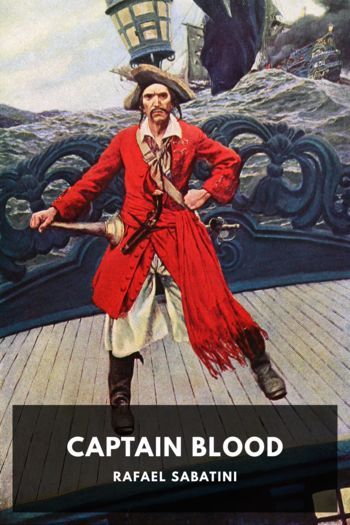
Peter Blood, with experience as a soldier and sailor, is practicing medicine in Bridgewater, England, when he inadvertently gets caught up in a rebellion being waged by the Duke of Monmouth. After being convicted of treason, Blood and some of the rebels are sentenced to slavery in the Caribbean. The year is 1688.
During the course of Blood’s servitude, he works on the sugar plantation of Colonel Bishop and becomes infatuated with the colonel’s niece, Arabella. When Bishop realizes that Blood is an accomplished physician he “employs” Blood in that capacity.
When the colony is attacked by a Spanish force, Blood and some of the other slaves manage to escape and take over the Spanish ship. Several of the other escapees turn out to be experienced seaman, including as officers in the British navy. This group turns the Spanish ship into a very successful pirate ship, specializing in raiding Spanish shipping.
This begins Captain Blood’s journey toward redemption and his “courtship” of Arabella.
Sabatini based Blood’s character on several historical figures, including a doctor who was sentenced to slavery (but did not become a pirate), as well as Henry Morgan (who was a pirate). His most well known novel was Scaramouche. Sabatini also wrote a number of short stories about Captain Blood in the early 1920s.

Description
Peter Pan, a young boy who refuses to grow up, takes Wendy to the lost boys on the fantasy island of the Neverland to be their mother. Wendy’s two brothers, John and Michael, accompany them on their many adventures, including skirmishes with the Native Americans who reside there, and battles with pirates, led by Pan’s nemesis Captain Hook, who is said to be feared even by Captain Flint and Long John Silver.
Peter and Wendy, J. M. Barrie’s most famous work, was influenced by Barrie’s relationship with the Llewelyn Davies family and the death of his older brother, who, by dying in his youth, would remain a young boy forever. It began as a play first performed in 1904, and then was later published as a novel in 1911. A large number of adaptations including plays, television, and films have since been produced.

Description
Bleak House, completed by Dickens in 1853, tells several interlocking story-lines and features a host of colorful characters. Though very difficult to summarise, the novel centers around the decades-long legal case of Jarndyce and Jarndyce, involving the fair distribution of assets of a valuable estate. The case is mired in the legal quagmire of the Court of Chancery, whose byzantine and sluggish workings Dickens spares no effort to expose and condemn. Dickens also exposes the miserable condition of the poor, living in squalid, pestilential circumstances.
The novel’s heroine is Esther Summerson, whose parentage is unclear and who has been brought up by a cold and strict godmother, who tells her only: “Your mother, Esther, is your disgrace, and you were hers.” On the death of her godmother, she is given an education through the unexpected intervention of a Mr. Jarndyce of Bleak House, whom she has never met. When she comes of age, she is appointed as a companion to Ada, one of two young people who are “wards of Chancery,” whose fates depend on the outcome of the legal struggle and who are taken into guardianship by Mr. Jarndyce. The other ward Richard, despite Mr. Jarndyce’s frequent warnings, eventually goes astray by pinning all his hopes on a successful outcome of Jarndyce and Jarndyce.
We are also introduced to Sir Leicester and Lady Dedlock, and to their cunning and suspicious lawyer, Mr. Tulkinghorn. He uncovers evidence that Lady Dedlock is not all she seems and determines to remorselessly pursue every lead to expose her secrets.
The novel has a curious construction in that the first-person narrative of Esther, written in the past tense, is interleaved with many chapters written from the omniscient viewpoint and in the present tense.
Several prominent critics such as G. K. Chesterton consider Bleak House to be Dickens’ finest novel, and it is often ranked among the best English-language novels of all time.

Description
Parnassus on Wheels is Christopher Morley’s first novel, and the first of two written from a woman’s perspective, the second being The Haunted Bookshop, this book’s sequel. Parnassus on Wheels was inspired by a novel by David Grayson (pseudonym of Ray Stannard Baker) called The Friendly Road, and is prefaced by a letter to Grayson from Morley. The word “Parnassus” from the title refers to “Mount Parnassus,” the home of the Muses in Greek mythology.
The protagonist is 39-year-old Helen McGill, who lives on a farm owned by her brother Andrew. The book’s Parnassus is a large, horse-drawn van owned by Roger Mifflin, out of which he buys and sells books while traveling around the New England countryside. Mifflin arrives at the McGill farm, looking to sell the business to someone interested in the noble cause of spreading literature to the common man. Helen is at first turned off by Mr. Mifflin, but decides on a whim that an escape from her dreadful farm—and her insufferable brother Andrew—is just what she needs. She buys the Parnassus, and embarks on exactly the type of adventure she had hoped for.
ed home his wife and children received him with the greatest joy. But instead of embracing them he began to weep so bitterly that they soon guessed that something terrible was the matter.
"Tell us, I pray you," said his wife, "what has happened."
"Alas!" answered her husband, "I have only a year to live."
Then he told them what had passed between him and the genius, and how he had given his word to return at the end of a year to be killed. When they heard this sad news they were in despair, and wept much.
The next day the merchant began to settle his affairs, and first of all to pay his debts. He gave presents to his friends, and large alms to the poor. He set his slaves at liberty, and provided for his wife and children. The year soon passed away, and he was obliged to depart. When he tried to say good-bye he was quite overcome with grief, and with difficulty tore himself away. At length he reached the place where he had first seen the genius, on the very day that he had appointed
ng you."
"Then, pray consult," said Holmes, shutting his eyes once more.
"The facts are briefly these: Some five years ago, during a lengthy visit to Warsaw, I made the acquaintance of the well-known adventuress, Irene Adler. The name is no doubt familiar to you."
"Kindly look her up in my index, Doctor," murmured Holmes without opening his eyes. For many years he had adopted a system of docketing all paragraphs concerning men and things, so that it was difficult to name a subject or a person on which he could not at once furnish information. In this case I found her biography sandwiched in between that of a Hebrew rabbi and that of a staff-commander who had written a monograph upon the deep-sea fishes.
"Let me see!" said Holmes. "Hum! Born in New Jersey in the year 1858. Contralto--hum! La Scala, hum! Prima donna Imperial Opera of Warsaw--yes! Retired from operatic stage--ha! Living in London--quite so! Your Majesty, as I understand, became entangled with this young person, wrote

Description
Though often packed into the genre of science fiction, R. A. Lafferty might fit better into a category of the bizzare. Through a blend of folk storytelling, American tall tales, science fiction, and fantasy, all infused with his devout Catholicism, he has created an inimitable, genre-bending, sui generis style.
Lafferty has received many Hugo and Nebula Award nominations and won the Best Short Story Hugo in 1973.
Collected here are all of his public domain short stories, all of which were originally published in science fiction pulp magazines in the 1960s.

Description
In the process of writing his memoirs, Arsène Lupin takes us back to his early twenties and his first love: Clarice d’Etigues. Although forbidden by her father to meet, that doesn’t stop Ralph d’Andresy—Lupin’s nom du jour—from wooing Clarice. But when he finds evidence on the d’Etigues estate of a conspiracy to murder a woman, he cannot help but be drawn into the ensuing three-way race to a legendary treasure.
Memoirs of Arsène Lupin was originally published in France in 1924 under the name La Comtesse de Cagliostro; this English translation was published the following year. Maurice Leblanc was not the only author to call on the myth of Cagliostro as a framing device: both Goethe and Dumas had written famous novels on the subject. This story showcases a Lupin who is growing into his abilities, and with the swings between outright confidence and self-doubt that would be expected of so comparatively young a protagonist.
Description
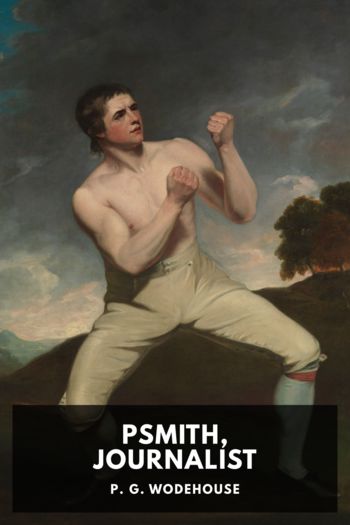
Growing bored while accompanying his Cambridge chum Mike on a cricket tour of the United States, Psmith seeks adventure in New York City. He finds it in the form of the weekly newspaper Cosy Moments, a completely bland and inoffensive publication at which, through charm and sheer force of personality, Psmith appoints himself an unpaid subeditor, fires the entire contributing staff, and embarks on a crusade against the slumlords, gangs, and boxing managers of his holiday destination.
Psmith, Journalist is the second of Wodehouse’s Psmith novels, and is a marked departure from the author’s usual settings and themes. It presents a very strong social justice theme with direct, harsh condemnation of exploitation, corruption, racism, and inequality in early-twentieth century America, and its themes continue to resonate with readers a century later.
The story first appeared in The Captain magazine from October 1909 to February 1910, and was first published as a book, including eight illustrations, by A & C Black in 1915. This Standard Ebook is based on the 1923 edition by the same publisher.

Description
Probably Virginia Woolf’s best-known novel, Mrs. Dalloway, originally published in 1925, is a glorious, ground-breaking text. On the surface, it follows Clarissa Dalloway, an Englishwoman in her fifties, minute by minute through the June day on which she is having a party. At a deeper level, however, the novel demonstrates, through an effortless stream of consciousness, the connections formed in human interaction—whether these interactions are fleeting, or persist through decades.
This is a novel to read and cherish, if only to marvel at Woolf’s linguistic acrobatics. Words and phrases swoop and soar like swallows. Woolf’s sentences are magnificent: sinuous, whirling, impeccably detailed. As narrative perspective shifts from character to character—sometimes within a single sentence—readers come to understand the oh-so-permeable barrier between self and other. Through Clarissa we meet Septimus Warren Smith, his wife Rezia, and a cast of dozens more, all connected by the “leaden circles” of Big Ben marking the passage of every hour, by the pavements of Bloomsbury that lead everywhere and nowhere. Modernist London has never been portrayed more sublimely: replete with birdsong and flowers, resplendent in sunshine, youthful yet eternal—and even in the aftermath of war and pandemic, resilient.
Mrs. Dalloway is Woolf’s attempt to express that which may be inexpressible. It offers a close examination of how difficult it is, even when our hearts are brimming, to say what we really feel; and it examines the damage we inflict through our reticence with words, our withholding of love. It is a novel of the soul, and a work of immense beauty.