ir background the physical world we live in and all its familiar accessories. Life on the sixth division is simply our ordinary life on this earth, minus the physical body and its necessities; while as it ascends through the fifth and fourth divisions it becomes less and less material, and is more and more withdrawn from our lower world and its interests.
The scenery of these lower divisions, then, is that of the earth as we know it: but it is also very much more; for when looked at from this different standpoint, with the assistance of the astral senses, even purely physical objects present a very different appearance. As has already been mentioned, they are seen by one whose eyes are fully opened, not as usual from one point of view, but from all sides at once--an idea in itself sufficiently confusing; and when we add to this that every particle in the interior of a solid body is as fully and clearly visible as those on the outside, it will be comprehended that under such conditions even the most fam

. The Fakir and His Jar of Butter c. The Fishes and the Crab d. The Crow and the Serpent e. The Wild Ass and the Jackal f. The Unjust King and the Pilgrim Prince g. The Crows and the Hawk h. The Serpent-Charmer and His Wife i. The Spider and the Wind j. The Two Kings k. The Blind Man and the Cripple l. The Foolish Fisherman m. The Boy and the Thieves n. The Man and his Wife o. The Merchant and the Robbers p. The Jackals and the Wolf q. The Shepherd and the Rogue r. The Francolin and the Tortoises 162. Abu Kir the Dyer and Abu Sir the Barber 163. Abdullah the Fisherman and Abdullah the Merman 164. Harun Al-Rashid and Abu Hasan, The Merchant of Oman 165. Ibrahim and Jamilah 166. Abu Al-Hasan of Khorasan 167. Kamar Al-Zaman and the Jeweller's Wife 168. Abdullah Bin Fazil and His Brothers
The Book Of The THOUSAND NIGHTS AND A NIGHT
When it was the Eight Hundred and Eighty-ninth Night,
She pursued, It hath reached me, O auspicious King, that when Nur al-Din heard the voice singing th
d will answer his purposes.
The plans and directions submitted in this work are intended to be of the most practical kind; plain, substantial, and applicable, throughout, to the purposes intended, and such as are within the reach--each in their kind--of every farmer in our country. These plans are chiefly original; that is, they are not copied from any in the books, or from any structures with which the writer is familiar. Yet they will doubtless, on examination, be found in several cases to resemble buildings, both in outward appearance and interior arrangement, with which numerous readers may be acquainted. The object, in addition to our own designs, has been to apply practical hints, gathered from other structures in use, which have seemed appropriate for a work of the limited extent here offered, and that may serve to improve the taste of all such as, in building useful structures, desire to embellish their farms and estates in an agreeable style of home architecture, at once pleasant to the eye, a

apsed since his death, and yet his ideas, doctrines and teachings are still quoted and accepted without any apparent diminution of their influence. Cicero had in mind an exact prototype of Jefferson when he said, "Homines ad deos nulla re propius accedunt quam salutem hominibus dando."[1]
[1] There is no way by which man can approach nearer to the gods than by contributing to the welfare of their fellow creatures.
Authentic history shows a persistent tendency of the Anglo-Saxon race in the unswerving direction of personal liberty. The inhabitants of the American Colonies revealed a tenacity and self-assertiveness in this direction to a greater extent than had ever been shown in England. The Jeffersonian idea has ever been that there shall be no king; that the sovereign ruler should be placed on the same level and be judged by the same principles as the humblest citizen; that the lords of the manors are entitled to no more privileges than the poorest peasant; that these rights are inalie

d he had worked on it a design of the village in which they lived. Mary's idea now was to fill this basket with flowers, and to offer it to the young Countess as her birthday present. Her father readily fell in with the plan, and added a finishing touch to it by weaving Amelia's name in on one side of the basket and the Count's coat-of-arms on the other.
The long-expected day arrived, and early in the morning Mary gathered the freshest and most beautiful roses, the richest pinks, and other flowers of beautiful colours. She picked out some green branches full of leaves, and arranged them in the basket, so that all the colours, though perfectly distinct, were sweetly and delicately blended. A light garland composed of rosebuds and moss was passed around the basket, and Amelia's name could be distinctly read enclosed in a coronet of forget-me-nots. The basket when completed was a thing of uncommon beauty.
When Mary went to the Castle with her basket-present, the young Countess Amelia was sitting at

hin gold chain with an object attached to it. He glanced at the object and then took off his spectacles to examine it more narrowly. 'What's the history of this?' he asked. 'Odd enough,' was the answer. 'You know the yew thicket in the shrubbery: well, a year or two back we were cleaning out the old well that used to be in the clearing here, and what do you suppose we found?'
'Is it possible that you found a body?' said the visitor, with an odd feeling of nervousness.
'We did that: but what's more, in every sense of the word, we found two.'
'Good Heavens! Two? Was there anything to show how they got there? Was this thing found with them?'
'It was. Amongst the rags of the clothes that were on one of the bodies. A bad business, whatever the story of it may have been. One body had the arms tight round the other. They must have been there thirty years or more--long enough before we came to this place. You may judge we filled the well up fast enough. Do you make anything of what's cut o
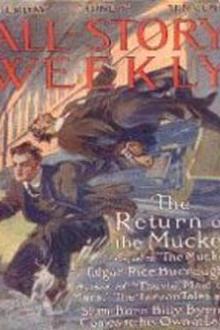
is prisoner ahead of him, started for the smoker. It was two cars ahead. The train was vestibuled. The first platform they crossed was tightly enclosed; but at the second Billy saw that a careless porter had left one of the doors open. The train was slowing down for some reason--it was going, perhaps, twenty miles an hour.
Billy was the first upon the platform. He was the first to see the open door. It meant one of two things--a chance to escape, or, death. Even the latter was to be preferred to life imprisonment.
Billy did not hesitate an instant. Even before the deputy sheriff realized that the door was open, his prisoner had leaped from the moving train dragging his guard after him.
CHAPTER II
THE ESCAPE
BYRNE had no time to pick any particular spot to jump for. When he did jump he might have been directly over a picket fence, or a bottomless pit--he did not know. Nor did he care.
As it happened he was ov
ladys Maud cried, because she had taken a sudden dislike to the village idiot; and Mike settled himself in the corner and opened a magazine.
He was alone in the carriage. Bob, who had been spending the last week of the holidays with an aunt further down the line, was to board the train at East Wobsley, and the brothers were to make a state entry into Wrykyn together. Meanwhile, Mike was left to his milk chocolate, his magazines, and his reflections.
The latter were not numerous, nor profound. He was excited. He had been petitioning the home authorities for the past year to be allowed to leave his private school and go to Wrykyn, and now the thing had come about. He wondered what sort of a house Wain's was, and whether they had any chance of the cricket cup. According to Bob they had no earthly; but then Bob only recognised one house, Donaldson's. He wondered if Bob would get his first eleven cap this year, and if he himself were likely to do anything at cricket. Marjory had faithfully reported e

cure of diseases by mental means. Müller's observation was in advance of his times, but could not be expected to include the results of the latest researches of modern science.
For a great many years physicians have recognized that not only are all diseases made worse by an incorrect mental attitude, but that some diseases are the direct result of worry and other mental disturbances. The mental force which causes colored water to act as an emetic, or postage-stamps to produce a blister, can also produce organic diseases of a serious nature. The large mental factor in the cause of diseases is generally admitted, and it seems reasonable to infer that what is caused by mental influence may be cured by the same means. There is no restriction in the power of the mind in causing disease, and should we restrict the mind as a factor in the cure? The trouble seems to be in the explanation. People ask, "How can the mind have such an effect upon the body?" and to the answer of this question we must now turn
a few weeks before, but the idea had spread through the crew like wildfire. Now, I couldn't afford drastic action, or risk forcing a blowup by arresting ringleaders. I had to baby the situation along with an easy hand and hope for good news from the Survey Section. A likely find now would save us.
There was still every reason to hope for success in our search. To date all had gone according to plan. We had followed the route of Omega as far as it had been charted, and then gone on, studying the stars ahead for evidence of planets. We had made our first finds early in the fourth year of the voyage. It had been a long tedious time since then of study and observation, eliminating one world after another as too massive, too cold, too close to a blazing primary, too small to hold an atmosphere. In all we had discovered twelve planets, of four suns. Only one had looked good enough for close observation. We had moved in to televideo range before realizing it was an all-sea world.
Now we had five new m
ir background the physical world we live in and all its familiar accessories. Life on the sixth division is simply our ordinary life on this earth, minus the physical body and its necessities; while as it ascends through the fifth and fourth divisions it becomes less and less material, and is more and more withdrawn from our lower world and its interests.
The scenery of these lower divisions, then, is that of the earth as we know it: but it is also very much more; for when looked at from this different standpoint, with the assistance of the astral senses, even purely physical objects present a very different appearance. As has already been mentioned, they are seen by one whose eyes are fully opened, not as usual from one point of view, but from all sides at once--an idea in itself sufficiently confusing; and when we add to this that every particle in the interior of a solid body is as fully and clearly visible as those on the outside, it will be comprehended that under such conditions even the most fam
. The Fakir and His Jar of Butter c. The Fishes and the Crab d. The Crow and the Serpent e. The Wild Ass and the Jackal f. The Unjust King and the Pilgrim Prince g. The Crows and the Hawk h. The Serpent-Charmer and His Wife i. The Spider and the Wind j. The Two Kings k. The Blind Man and the Cripple l. The Foolish Fisherman m. The Boy and the Thieves n. The Man and his Wife o. The Merchant and the Robbers p. The Jackals and the Wolf q. The Shepherd and the Rogue r. The Francolin and the Tortoises 162. Abu Kir the Dyer and Abu Sir the Barber 163. Abdullah the Fisherman and Abdullah the Merman 164. Harun Al-Rashid and Abu Hasan, The Merchant of Oman 165. Ibrahim and Jamilah 166. Abu Al-Hasan of Khorasan 167. Kamar Al-Zaman and the Jeweller's Wife 168. Abdullah Bin Fazil and His Brothers
The Book Of The THOUSAND NIGHTS AND A NIGHT
When it was the Eight Hundred and Eighty-ninth Night,
She pursued, It hath reached me, O auspicious King, that when Nur al-Din heard the voice singing th
d will answer his purposes.
The plans and directions submitted in this work are intended to be of the most practical kind; plain, substantial, and applicable, throughout, to the purposes intended, and such as are within the reach--each in their kind--of every farmer in our country. These plans are chiefly original; that is, they are not copied from any in the books, or from any structures with which the writer is familiar. Yet they will doubtless, on examination, be found in several cases to resemble buildings, both in outward appearance and interior arrangement, with which numerous readers may be acquainted. The object, in addition to our own designs, has been to apply practical hints, gathered from other structures in use, which have seemed appropriate for a work of the limited extent here offered, and that may serve to improve the taste of all such as, in building useful structures, desire to embellish their farms and estates in an agreeable style of home architecture, at once pleasant to the eye, a
apsed since his death, and yet his ideas, doctrines and teachings are still quoted and accepted without any apparent diminution of their influence. Cicero had in mind an exact prototype of Jefferson when he said, "Homines ad deos nulla re propius accedunt quam salutem hominibus dando."[1]
[1] There is no way by which man can approach nearer to the gods than by contributing to the welfare of their fellow creatures.
Authentic history shows a persistent tendency of the Anglo-Saxon race in the unswerving direction of personal liberty. The inhabitants of the American Colonies revealed a tenacity and self-assertiveness in this direction to a greater extent than had ever been shown in England. The Jeffersonian idea has ever been that there shall be no king; that the sovereign ruler should be placed on the same level and be judged by the same principles as the humblest citizen; that the lords of the manors are entitled to no more privileges than the poorest peasant; that these rights are inalie
d he had worked on it a design of the village in which they lived. Mary's idea now was to fill this basket with flowers, and to offer it to the young Countess as her birthday present. Her father readily fell in with the plan, and added a finishing touch to it by weaving Amelia's name in on one side of the basket and the Count's coat-of-arms on the other.
The long-expected day arrived, and early in the morning Mary gathered the freshest and most beautiful roses, the richest pinks, and other flowers of beautiful colours. She picked out some green branches full of leaves, and arranged them in the basket, so that all the colours, though perfectly distinct, were sweetly and delicately blended. A light garland composed of rosebuds and moss was passed around the basket, and Amelia's name could be distinctly read enclosed in a coronet of forget-me-nots. The basket when completed was a thing of uncommon beauty.
When Mary went to the Castle with her basket-present, the young Countess Amelia was sitting at
hin gold chain with an object attached to it. He glanced at the object and then took off his spectacles to examine it more narrowly. 'What's the history of this?' he asked. 'Odd enough,' was the answer. 'You know the yew thicket in the shrubbery: well, a year or two back we were cleaning out the old well that used to be in the clearing here, and what do you suppose we found?'
'Is it possible that you found a body?' said the visitor, with an odd feeling of nervousness.
'We did that: but what's more, in every sense of the word, we found two.'
'Good Heavens! Two? Was there anything to show how they got there? Was this thing found with them?'
'It was. Amongst the rags of the clothes that were on one of the bodies. A bad business, whatever the story of it may have been. One body had the arms tight round the other. They must have been there thirty years or more--long enough before we came to this place. You may judge we filled the well up fast enough. Do you make anything of what's cut o
is prisoner ahead of him, started for the smoker. It was two cars ahead. The train was vestibuled. The first platform they crossed was tightly enclosed; but at the second Billy saw that a careless porter had left one of the doors open. The train was slowing down for some reason--it was going, perhaps, twenty miles an hour.
Billy was the first upon the platform. He was the first to see the open door. It meant one of two things--a chance to escape, or, death. Even the latter was to be preferred to life imprisonment.
Billy did not hesitate an instant. Even before the deputy sheriff realized that the door was open, his prisoner had leaped from the moving train dragging his guard after him.
CHAPTER II
THE ESCAPE
BYRNE had no time to pick any particular spot to jump for. When he did jump he might have been directly over a picket fence, or a bottomless pit--he did not know. Nor did he care.
As it happened he was ov
ladys Maud cried, because she had taken a sudden dislike to the village idiot; and Mike settled himself in the corner and opened a magazine.
He was alone in the carriage. Bob, who had been spending the last week of the holidays with an aunt further down the line, was to board the train at East Wobsley, and the brothers were to make a state entry into Wrykyn together. Meanwhile, Mike was left to his milk chocolate, his magazines, and his reflections.
The latter were not numerous, nor profound. He was excited. He had been petitioning the home authorities for the past year to be allowed to leave his private school and go to Wrykyn, and now the thing had come about. He wondered what sort of a house Wain's was, and whether they had any chance of the cricket cup. According to Bob they had no earthly; but then Bob only recognised one house, Donaldson's. He wondered if Bob would get his first eleven cap this year, and if he himself were likely to do anything at cricket. Marjory had faithfully reported e
cure of diseases by mental means. Müller's observation was in advance of his times, but could not be expected to include the results of the latest researches of modern science.
For a great many years physicians have recognized that not only are all diseases made worse by an incorrect mental attitude, but that some diseases are the direct result of worry and other mental disturbances. The mental force which causes colored water to act as an emetic, or postage-stamps to produce a blister, can also produce organic diseases of a serious nature. The large mental factor in the cause of diseases is generally admitted, and it seems reasonable to infer that what is caused by mental influence may be cured by the same means. There is no restriction in the power of the mind in causing disease, and should we restrict the mind as a factor in the cure? The trouble seems to be in the explanation. People ask, "How can the mind have such an effect upon the body?" and to the answer of this question we must now turn
a few weeks before, but the idea had spread through the crew like wildfire. Now, I couldn't afford drastic action, or risk forcing a blowup by arresting ringleaders. I had to baby the situation along with an easy hand and hope for good news from the Survey Section. A likely find now would save us.
There was still every reason to hope for success in our search. To date all had gone according to plan. We had followed the route of Omega as far as it had been charted, and then gone on, studying the stars ahead for evidence of planets. We had made our first finds early in the fourth year of the voyage. It had been a long tedious time since then of study and observation, eliminating one world after another as too massive, too cold, too close to a blazing primary, too small to hold an atmosphere. In all we had discovered twelve planets, of four suns. Only one had looked good enough for close observation. We had moved in to televideo range before realizing it was an all-sea world.
Now we had five new m