
refore the great Augustus himself, in the possession of that power which ruled the world, acknowledged he could not make a new Latin word: which was as much as to say, that he could not arbitrarily appoint what idea any sound should be a sign of, in the mouths and common language of his subjects. It is true, common use, by a tacit consent, appropriates certain sounds to certain ideas in all languages, which so far limits the signification of that sound, that unless a man applies it to the same idea, he does not speak properly: and let me add, that unless a man's words excite the same ideas in the hearer which he makes them stand for in speaking, he does not speak intelligibly. But whatever be the consequence of any man's using of words differently, either from their general meaning, or the particular sense of the person to whom he addresses them; this is certain, their signification, in his use of them, is limited to his ideas, and they can be signs of nothing else.
out the air lock or loafing on the surface. You wouldn't believe how blue the waves could be. They tell me on Rustum you can't come down off the mountain tops."
"But we'd have the whole planet to ourselves," said Teresa Zeleny.
One with a gentle scholar's face answered: "That may be precisely the trouble, my dear. Three thousand of us, counting children, totally isolated from the human mainstream. Can we hope to build a civilization? Or even maintain one?"
"Your problem, pop," said the officer beside him dryly, "is that there are no medieval manuscripts on Rustum."
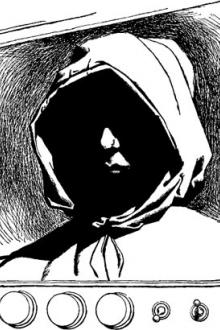
[Illustration]
"I admit it," said the scholar. "I thought it more important my children grow up able to use their minds. But if it turns out they can do so on Earth--How much chance will the first generations on Rustum have to sit down and really think, anyway?"
"Would there even be a next generation on Rustum?"
"One and a quarter gravities--I can feel it now."
"Synthetics, year after year of
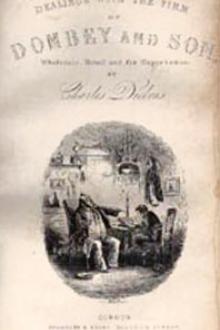
l make it. My dear Paul, it's very weak and silly of me, I know, to be so trembly and shaky from head to foot; but I am so very queer that I must ask you for a glass of wine and a morsel of that cake.'
Mr Dombey promptly supplied her with these refreshments from a tray on the table.
'I shall not drink my love to you, Paul,' said Louisa: 'I shall drink to the little Dombey. Good gracious me!--it's the most astonishing thing I ever knew in all my days, he's such a perfect Dombey.'
Quenching this expression of opinion in a short hysterical laugh which terminated in tears, Louisa cast up her eyes, and emptied her glass.
'I know it's very weak and silly of me,' she repeated, 'to be so trembly and shaky from head to foot, and to allow my feelings so completely to get the better of me, but I cannot help it. I thought I should have fallen out of the staircase window as I came down from seeing dear Fanny, and that tiddy ickle sing.' These last words originated in a sudden vivid reminiscence

ut authority and applied torture to an unconvictedsoldier, and Perrot, who sold liquor by the pint and thehalf-pint in his own house, were unworthy representativesof the crown.
By 1710 the population of Acadia had grown to abouttwenty-one hundred souls, distributed chiefly in thedistricts of Port Royal, Minas, and Chignecto. Most ofthese were descended from the settlers brought over byRazilly and Charnisay between 1633 and 1638. On the whole,they were a strong, healthy, virtuous people, sincerelyattached to their religion and their traditions. The mostnotable singularity of their race was stubbornness,although they could be led by kindness where they couldnot be driven by force. Though inclined to litigation,they were not unwilling to arbitrate their differences.They 'had none who were bred mechanics; every farmer washis own architect and every man of property a farmer.''The term Mister was unknown among them.' They took pridein their appearance and wore most attractive costumes,in which

ncy?"
"Leave Beaugency to me, gentle duke; I will have it in two hours, and at no cost of blood."
"It is true, Excellency. You will but need to deliver this news there and receive the surrender."
"Yes. And I will be with you at Meung with the dawn, fetching the Constable and his fifteen hundred; and when Talbot knows that Beaugency has fallen it will have an effect upon him."
"By the mass, yes!" cried La Hire. "He will join his Meung garrison to his army and break for Paris. Then we shall have our bridge force with us again, along with our Beaugency watchers, and be stronger for our great day's work by four-and-twenty hundred able soldiers, as was here promised within the hour. Verily this Englishman is doing our errands for us and saving us much blood and trouble. Orders, Excellency--give us orders!"
"They are simple. Let the men rest three hours longer. At one o'clock the advance-guard will march, under our command, with Pothon of Saintrailles as second; the second divisio

the ancient methods of industry madethis possible would delay us too much. I shall only stop now tosay that interest on investments was a species of tax in perpetuityupon the product of those engaged in industry which a personpossessing or inheriting money was able to levy. It must not besupposed that an arrangement which seems so unnatural andpreposterous according to modern notions was never criticized byyour ancestors. It had been the effort of lawgivers and prophetsfrom the earliest ages to abolish interest, or at least to limit it tothe smallest possible rate. All these efforts had, however, failed,as they necessarily must so long as the ancient social organizationsprevailed. At the time of which I write, the latter part ofthe nineteenth century, governments had generally given uptrying to regulate the subject at all.
By way of attempting to give the reader some general impressionof the way people lived together in those days, andespecially of the relations of the rich and poor to one

nd and wife. We infantrymen must bring the child into the world when a victory is to be born. The artillery has only the pleasure, just like a man's part in love. It is not until after the child has been baptized that he comes strutting out proudly. Am I not right, Captain?" he asked, appealing to the cavalry officer. "You are an equestrian on foot now, too."
The captain boomed his assent. In his summary view, members of the Reichstag who refused to vote enough money for the military, Socialists, pacifists, all men, in brief, who lectured or wrote or spoke superfluous stuff and lived by their brains belonged in the same category as the Philosopher. They were all "bookworms."
"Yes, indeed," he said in his voice hoarse from shouting commands. "A philosopher like our friend here is just the right person for the artillery. Nothing to do but wait around on the top of a hill and look on. If only they don't shoot up our own men! It is easy enough to dispose of the fellows on the other side, in front of

mall-pox, was agreeable in its expression, and full of intelligence. At this time he began to neglect his business, and becoming vain of his person, indulged in considerable extravagance of attire. He was a great favourite with the ladies, by whom he was called Beau Law; while the other sex, despising his foppery, nicknamed him Jessamy John. At the death of his father, which happened in 1688, he withdrew entirely from the desk, which had become so irksome, and being possessed of the revenues of the paternal estate of Lauriston, he proceeded to London, to see the world.
He was now very young, very vain, good-looking, tolerably rich, and quite uncontrolled. It is no wonder that, on his arrival in the capital, he should launch out into extravagance. He soon became a regular frequenter of the gaming-houses, and by pursuing a certain plan, based upon some abstruse calculation of chances, he contrived to gain considerable sums. All the gamblers envied him his luck, and many made it a point to watch his play,

he Beth-horon Route--The Amorites defeated but not surrounded--King David as a Strategist. THE MIRACLE--The Noon-day Heat, the great Hindrance to the Israelites--Joshua desired the Heat to be tempered--The Sun made to "be silent"--The Hailstorm--The March to Makkedah--A Full Day's March in the Afternoon--"The Miracle" not a Poetic Hyperbole--Exact Accord of the Poem and the Prose Chronicle--The Record made at the Time--Their March, the Israelites' Measure of Time 351
CHAPTER II.
THE DIAL OF AHAZ
The Narrative--Suggested Explanations--The "Dial of Ahaz," probably a Staircase--Probable History and Position of the Staircase--Significance of the Sign 385
CHAPTER III.
THE STAR OF BETHLEHEM
The Narrative--No Astronomical Details given--Purpose of the Scripture Narrative--Kepler's suggested Identification of the Star--The New Star of 1572--Legend of

The reference was clearly to a nonhuman species of incredible properties, not indigenous to Earth. A species, I hasten to point out, customarily masquerading as ordinary human beings. Their disguise, however, became transparent in the face of the following observations by the author. It was at once obvious the author knew everything. Knew everything--and was taking it in his stride. The line (and I tremble remembering it even now) read:
... his eyes slowly roved about the room.
Vague chills assailed me. I tried to picture the eyes. Did they roll like dimes? The passage indicated not; they seemed to move through the air, not over the surface. Rather rapidly, apparently. No one in the story was surprised. That's what tipped me off. No sign of amazement at such an outrageous thing. Later the matter was amplified.
... his eyes moved from person to person.
There it was in a nutshell. The eyes had clearly come apart from the rest of him and were on their own.
refore the great Augustus himself, in the possession of that power which ruled the world, acknowledged he could not make a new Latin word: which was as much as to say, that he could not arbitrarily appoint what idea any sound should be a sign of, in the mouths and common language of his subjects. It is true, common use, by a tacit consent, appropriates certain sounds to certain ideas in all languages, which so far limits the signification of that sound, that unless a man applies it to the same idea, he does not speak properly: and let me add, that unless a man's words excite the same ideas in the hearer which he makes them stand for in speaking, he does not speak intelligibly. But whatever be the consequence of any man's using of words differently, either from their general meaning, or the particular sense of the person to whom he addresses them; this is certain, their signification, in his use of them, is limited to his ideas, and they can be signs of nothing else.
out the air lock or loafing on the surface. You wouldn't believe how blue the waves could be. They tell me on Rustum you can't come down off the mountain tops."
"But we'd have the whole planet to ourselves," said Teresa Zeleny.
One with a gentle scholar's face answered: "That may be precisely the trouble, my dear. Three thousand of us, counting children, totally isolated from the human mainstream. Can we hope to build a civilization? Or even maintain one?"
"Your problem, pop," said the officer beside him dryly, "is that there are no medieval manuscripts on Rustum."
[Illustration]
"I admit it," said the scholar. "I thought it more important my children grow up able to use their minds. But if it turns out they can do so on Earth--How much chance will the first generations on Rustum have to sit down and really think, anyway?"
"Would there even be a next generation on Rustum?"
"One and a quarter gravities--I can feel it now."
"Synthetics, year after year of
l make it. My dear Paul, it's very weak and silly of me, I know, to be so trembly and shaky from head to foot; but I am so very queer that I must ask you for a glass of wine and a morsel of that cake.'
Mr Dombey promptly supplied her with these refreshments from a tray on the table.
'I shall not drink my love to you, Paul,' said Louisa: 'I shall drink to the little Dombey. Good gracious me!--it's the most astonishing thing I ever knew in all my days, he's such a perfect Dombey.'
Quenching this expression of opinion in a short hysterical laugh which terminated in tears, Louisa cast up her eyes, and emptied her glass.
'I know it's very weak and silly of me,' she repeated, 'to be so trembly and shaky from head to foot, and to allow my feelings so completely to get the better of me, but I cannot help it. I thought I should have fallen out of the staircase window as I came down from seeing dear Fanny, and that tiddy ickle sing.' These last words originated in a sudden vivid reminiscence
ut authority and applied torture to an unconvictedsoldier, and Perrot, who sold liquor by the pint and thehalf-pint in his own house, were unworthy representativesof the crown.
By 1710 the population of Acadia had grown to abouttwenty-one hundred souls, distributed chiefly in thedistricts of Port Royal, Minas, and Chignecto. Most ofthese were descended from the settlers brought over byRazilly and Charnisay between 1633 and 1638. On the whole,they were a strong, healthy, virtuous people, sincerelyattached to their religion and their traditions. The mostnotable singularity of their race was stubbornness,although they could be led by kindness where they couldnot be driven by force. Though inclined to litigation,they were not unwilling to arbitrate their differences.They 'had none who were bred mechanics; every farmer washis own architect and every man of property a farmer.''The term Mister was unknown among them.' They took pridein their appearance and wore most attractive costumes,in which
ncy?"
"Leave Beaugency to me, gentle duke; I will have it in two hours, and at no cost of blood."
"It is true, Excellency. You will but need to deliver this news there and receive the surrender."
"Yes. And I will be with you at Meung with the dawn, fetching the Constable and his fifteen hundred; and when Talbot knows that Beaugency has fallen it will have an effect upon him."
"By the mass, yes!" cried La Hire. "He will join his Meung garrison to his army and break for Paris. Then we shall have our bridge force with us again, along with our Beaugency watchers, and be stronger for our great day's work by four-and-twenty hundred able soldiers, as was here promised within the hour. Verily this Englishman is doing our errands for us and saving us much blood and trouble. Orders, Excellency--give us orders!"
"They are simple. Let the men rest three hours longer. At one o'clock the advance-guard will march, under our command, with Pothon of Saintrailles as second; the second divisio
the ancient methods of industry madethis possible would delay us too much. I shall only stop now tosay that interest on investments was a species of tax in perpetuityupon the product of those engaged in industry which a personpossessing or inheriting money was able to levy. It must not besupposed that an arrangement which seems so unnatural andpreposterous according to modern notions was never criticized byyour ancestors. It had been the effort of lawgivers and prophetsfrom the earliest ages to abolish interest, or at least to limit it tothe smallest possible rate. All these efforts had, however, failed,as they necessarily must so long as the ancient social organizationsprevailed. At the time of which I write, the latter part ofthe nineteenth century, governments had generally given uptrying to regulate the subject at all.
By way of attempting to give the reader some general impressionof the way people lived together in those days, andespecially of the relations of the rich and poor to one
nd and wife. We infantrymen must bring the child into the world when a victory is to be born. The artillery has only the pleasure, just like a man's part in love. It is not until after the child has been baptized that he comes strutting out proudly. Am I not right, Captain?" he asked, appealing to the cavalry officer. "You are an equestrian on foot now, too."
The captain boomed his assent. In his summary view, members of the Reichstag who refused to vote enough money for the military, Socialists, pacifists, all men, in brief, who lectured or wrote or spoke superfluous stuff and lived by their brains belonged in the same category as the Philosopher. They were all "bookworms."
"Yes, indeed," he said in his voice hoarse from shouting commands. "A philosopher like our friend here is just the right person for the artillery. Nothing to do but wait around on the top of a hill and look on. If only they don't shoot up our own men! It is easy enough to dispose of the fellows on the other side, in front of
mall-pox, was agreeable in its expression, and full of intelligence. At this time he began to neglect his business, and becoming vain of his person, indulged in considerable extravagance of attire. He was a great favourite with the ladies, by whom he was called Beau Law; while the other sex, despising his foppery, nicknamed him Jessamy John. At the death of his father, which happened in 1688, he withdrew entirely from the desk, which had become so irksome, and being possessed of the revenues of the paternal estate of Lauriston, he proceeded to London, to see the world.
He was now very young, very vain, good-looking, tolerably rich, and quite uncontrolled. It is no wonder that, on his arrival in the capital, he should launch out into extravagance. He soon became a regular frequenter of the gaming-houses, and by pursuing a certain plan, based upon some abstruse calculation of chances, he contrived to gain considerable sums. All the gamblers envied him his luck, and many made it a point to watch his play,
he Beth-horon Route--The Amorites defeated but not surrounded--King David as a Strategist. THE MIRACLE--The Noon-day Heat, the great Hindrance to the Israelites--Joshua desired the Heat to be tempered--The Sun made to "be silent"--The Hailstorm--The March to Makkedah--A Full Day's March in the Afternoon--"The Miracle" not a Poetic Hyperbole--Exact Accord of the Poem and the Prose Chronicle--The Record made at the Time--Their March, the Israelites' Measure of Time 351
CHAPTER II.
THE DIAL OF AHAZ
The Narrative--Suggested Explanations--The "Dial of Ahaz," probably a Staircase--Probable History and Position of the Staircase--Significance of the Sign 385
CHAPTER III.
THE STAR OF BETHLEHEM
The Narrative--No Astronomical Details given--Purpose of the Scripture Narrative--Kepler's suggested Identification of the Star--The New Star of 1572--Legend of
The reference was clearly to a nonhuman species of incredible properties, not indigenous to Earth. A species, I hasten to point out, customarily masquerading as ordinary human beings. Their disguise, however, became transparent in the face of the following observations by the author. It was at once obvious the author knew everything. Knew everything--and was taking it in his stride. The line (and I tremble remembering it even now) read:
... his eyes slowly roved about the room.
Vague chills assailed me. I tried to picture the eyes. Did they roll like dimes? The passage indicated not; they seemed to move through the air, not over the surface. Rather rapidly, apparently. No one in the story was surprised. That's what tipped me off. No sign of amazement at such an outrageous thing. Later the matter was amplified.
... his eyes moved from person to person.
There it was in a nutshell. The eyes had clearly come apart from the rest of him and were on their own.