
ter took up the portfolio, opened it, put it down, hesitated, seemed about to speak. "Perhaps," he whispered doubtfully. Presently he glanced at the door and back to the figure. Then he stole on tiptoe out of the room, glancing at his companion after each elaborate pace.
He closed the door noiselessly. The house door was standing open, and he went out beyond the porch, and stood where the monkshood rose at the corner of the garden bed. From this point he could see the stranger through the open window, still and dim, sitting head on hand. He had not moved.
A number of children going along the road stopped and regarded the artist curiously. A boatman exchanged civilities with him. He felt that possibly his circumspect attitude and position looked peculiar and unaccountable. Smoking, perhaps, might seem more natural. He drew pipe and pouch from his pocket, filled the pipe slowly.
"I wonder," ... he said, with a scarcely perceptible loss of complacency. "At any rate one must give him a chance
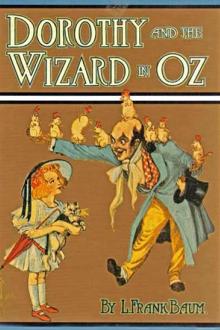
d at Zeb, whose face was blue and whose hair was pink, and gave a little laugh that sounded a bit nervous.
"Isn't it funny?" she said.
The boy was startled and his eyes were big. Dorothy had a green streak through the center of her face where the blue and yellow lights came together, and her appearance seemed to add to his fright.
"I--I don't s-s-see any-thing funny--'bout it!" he stammered.
[Illustration: HORSE, BUGGY AND ALL FELL SLOWLY.]
Just then the buggy tipped slowly over upon its side, the body of the horse tipping also. But they continued to fall, all together, and the boy and girl had no difficulty in remaining upon the seat, just as they were before. Then they turned bottom side up, and continued to roll slowly over until they were right side up again. During this time Jim struggled frantically, all his legs kicking the air; but on finding himself in his former position the horse said, in a relieved tone of voice:
"Well, that's better!"
Dorothy and Z
ow long ago? He marveled at how the priestesses had managed to keep this one icon in pristine condition. He could understand why the pilgrims felt
the magic in it, even if he did not.
"Estamos refugiados en una zona de apagon." The priestess, in a high, squeaky voice, rained down nonsense from the balcony. "Nuestras casas desarraigados, arrastrando raÃces profundas de concreta, fibrosas con tubos y conectores, giran y saltan a las fluctuaciones del campo de gravitacion. Â La gente tienen miedo." She droned on like that, and Donal found himself scanning the crowd, idly yet thoroughly, to see if anyone unsavory might have snuck through the front gate.
There had been a small group, armed with pieces of metal no larger than their fingernails but sharpened enough to cut, and they had slipped in and managed to kill a handful of guests and Castle workers before they were hacked to bits. The memory was bitterly fresh. But no one in the group of soft, milli

The Blue Cross
The Secret Garden
The Queer Feet
The Flying Stars
The Invisible Man
The Honour of Israel Gow
The Wrong Shape
The Sins of Prince Saradine
The Hammer of God
The Eye of Apollo
The Sign of the Broken Sword
The Three Tools of Death
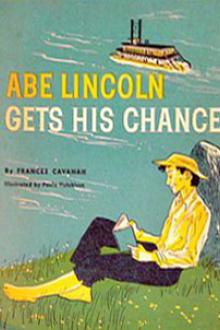
Another scholar would greet "the stranger," lead him around the room, and introduce him.
One day it was Abe's turn to do the introducing. He opened the door to find his best friend, Nat Grigsby, waiting outside. Nat bowed low, from the waist. Abe bowed. His buckskin trousers, already too short, slipped up still farther, showing several inches of his bare leg. He looked so solemn that some of the girls giggled. The schoolmaster frowned and pounded on his desk. The giggling stopped.
"Master Crawford," said Abe, "this here is Mr. Grigsby. His pa just moved to these parts. He figures on coming to your school."
Andrew Crawford rose and bowed. "Welcome," he said. "Mr. Lincoln, introduce Mr. Grigsby to the other scholars."
[Illustration]
The children sat on two long benches made of split logs. Abe led Nat down the length of the front bench. Each girl rose and made a curtsy. Nat bowed. Each boy rose and bowed. Nat returned the bow. Abe kept saying funny things under his breath that

little later I heard the stroke of oars, growing nearer and nearer, and the calls of a man. When he was very near I heard him crying, in vexed fashion, "Why in hell don't you sing out?" This meant me, I thought, and then the blankness and darkness rose over me.
CHAPTER II
I seemed swinging in a mighty rhythm through orbit vastness. Sparkling points of light spluttered and shot past me. They were stars, I knew, and flaring comets, that peopled my flight among the suns. As I reached the limit of my swing and prepared to rush back on the counter swing, a great gong struck and thundered. For an immeasurable period, lapped in the rippling of placid centuries, I enjoyed and pondered my tremendous flight.
But a change came over the face of the dream, for a dream I told myself it must be. My rhythm grew shorter and shorter. I was jerked from swing to counter swing with irritating haste. I could scarcely catch my breath, so fiercely

s are indispensable, and I am not without hope that the sense of secure advancement, and the pleasure of independent effort, may render the following out of even the more tedious exercises here proposed, possible to the solitary learner, without weariness. But if it should be otherwise, and he finds the first steps painfully irksome, I can only desire him to consider whether the acquirement of so great a power as that of pictorial expression of thought be not worth some toil; or whether it is likely, in the natural order of matters in this working world, that so great a gift should be attainable by those who will give no price for it.
xii. One task, however, of some difficulty, the student will find I have not imposed upon him: namely, learning the laws of perspective. It would be worth while to learn them, if he could do so easily; but without a master's help, and in the way perspective is at present explained in treatises, the difficulty is greater than the gain. For perspective is not of the slighte
gates.
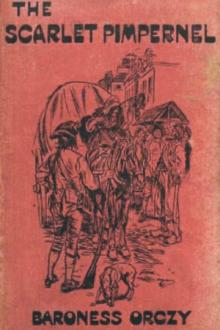
"What cart?" asked Bibot, roughly.
"Driven by an old hag. . . . A covered cart . . ."
"There were a dozen . . ."
"An old hag who said her son had the plague?"
"Yes . . ."
"You have not let them go?"
"MORBLEU!" said Bibot, whose purple cheeks had suddenly become white with fear.
"The cart contained the CI-DEVANT Comtesse de Tourney and her two children, all of them traitors and condemned to death." "And their driver?" muttered Bibot, as a superstitious shudder ran down his spine.
"SACRE TONNERRE," said the captain, "but it is feared that it was that accursed Englishman himself--the Scarlet Pimpernel."
CHAPTER II
DOVER: "THE FISHERMAN'S REST"
In the kitchen Sally was extremely busy--saucepans and frying-pans were standing in rows on the gigantic hearth, the huge stock-pot stood in a corner, and the jack turned with slow deliberation, and presented alternately to the glow

narrative, which shallcomprehend this period of social disorganization, must beascribed entirely to the skill and luminous disposition of thehistorian. It is in this sublime Gothic architecture of hiswork, in which the boundless range, the infinite variety, the, atfirst sight, incongruous gorgeousness of the separate parts,nevertheless are all subordinate to one main and predominantidea, that Gibbon is unrivalled. We cannot but admire the mannerin which he masses his materials, and arranges his facts insuccessive groups, not according to chronological order, but totheir moral or political connection; the distinctness with whichhe marks his periods of gradually increasing decay; and the skillwith which, though advancing on separate parallels of history, heshows the common tendency of the slower or more rapid religiousor civil innovations. However these principles of compositionmay demand more than ordinary attention on the part of thereader, they can alone impress upon the memory the real c

He hit me and threw me into the wall. I'm sorry, Greg, I shouldn't be calling you, but--"
Greg heard a man shouting in the background, then a commotion. The phone went dead. He felt sick and helpless, like a kid who had just been spun on a merry-go-round at breakneck speed until he flew off. And the dizziness would not soon go away.
Greg wanted to call the police, but what would he tell them? And why did she call him instead of 911? He would call her back. No, he couldn't--he didn't have her number.
Then he felt something on his leg. The ice cream was melting beneath the chocolate shell, and it had collapsed under its own weight, and fallen onto the bed of napkins in his lap.
Still dazed, he sat for a full minute studying the ice cream as it dripped down the sides of the cone onto his hand and arm. Gradually the streams of white turned to pink, then to red-- running down Cynthia's face! A cold chill ripped through his body, and jolted him back to reality. He dropped the cone onto t
ter took up the portfolio, opened it, put it down, hesitated, seemed about to speak. "Perhaps," he whispered doubtfully. Presently he glanced at the door and back to the figure. Then he stole on tiptoe out of the room, glancing at his companion after each elaborate pace.
He closed the door noiselessly. The house door was standing open, and he went out beyond the porch, and stood where the monkshood rose at the corner of the garden bed. From this point he could see the stranger through the open window, still and dim, sitting head on hand. He had not moved.
A number of children going along the road stopped and regarded the artist curiously. A boatman exchanged civilities with him. He felt that possibly his circumspect attitude and position looked peculiar and unaccountable. Smoking, perhaps, might seem more natural. He drew pipe and pouch from his pocket, filled the pipe slowly.
"I wonder," ... he said, with a scarcely perceptible loss of complacency. "At any rate one must give him a chance
d at Zeb, whose face was blue and whose hair was pink, and gave a little laugh that sounded a bit nervous.
"Isn't it funny?" she said.
The boy was startled and his eyes were big. Dorothy had a green streak through the center of her face where the blue and yellow lights came together, and her appearance seemed to add to his fright.
"I--I don't s-s-see any-thing funny--'bout it!" he stammered.
[Illustration: HORSE, BUGGY AND ALL FELL SLOWLY.]
Just then the buggy tipped slowly over upon its side, the body of the horse tipping also. But they continued to fall, all together, and the boy and girl had no difficulty in remaining upon the seat, just as they were before. Then they turned bottom side up, and continued to roll slowly over until they were right side up again. During this time Jim struggled frantically, all his legs kicking the air; but on finding himself in his former position the horse said, in a relieved tone of voice:
"Well, that's better!"
Dorothy and Z
ow long ago? He marveled at how the priestesses had managed to keep this one icon in pristine condition. He could understand why the pilgrims felt
the magic in it, even if he did not.
"Estamos refugiados en una zona de apagon." The priestess, in a high, squeaky voice, rained down nonsense from the balcony. "Nuestras casas desarraigados, arrastrando raÃces profundas de concreta, fibrosas con tubos y conectores, giran y saltan a las fluctuaciones del campo de gravitacion. Â La gente tienen miedo." She droned on like that, and Donal found himself scanning the crowd, idly yet thoroughly, to see if anyone unsavory might have snuck through the front gate.
There had been a small group, armed with pieces of metal no larger than their fingernails but sharpened enough to cut, and they had slipped in and managed to kill a handful of guests and Castle workers before they were hacked to bits. The memory was bitterly fresh. But no one in the group of soft, milli
The Blue Cross
The Secret Garden
The Queer Feet
The Flying Stars
The Invisible Man
The Honour of Israel Gow
The Wrong Shape
The Sins of Prince Saradine
The Hammer of God
The Eye of Apollo
The Sign of the Broken Sword
The Three Tools of Death
Another scholar would greet "the stranger," lead him around the room, and introduce him.
One day it was Abe's turn to do the introducing. He opened the door to find his best friend, Nat Grigsby, waiting outside. Nat bowed low, from the waist. Abe bowed. His buckskin trousers, already too short, slipped up still farther, showing several inches of his bare leg. He looked so solemn that some of the girls giggled. The schoolmaster frowned and pounded on his desk. The giggling stopped.
"Master Crawford," said Abe, "this here is Mr. Grigsby. His pa just moved to these parts. He figures on coming to your school."
Andrew Crawford rose and bowed. "Welcome," he said. "Mr. Lincoln, introduce Mr. Grigsby to the other scholars."
[Illustration]
The children sat on two long benches made of split logs. Abe led Nat down the length of the front bench. Each girl rose and made a curtsy. Nat bowed. Each boy rose and bowed. Nat returned the bow. Abe kept saying funny things under his breath that
little later I heard the stroke of oars, growing nearer and nearer, and the calls of a man. When he was very near I heard him crying, in vexed fashion, "Why in hell don't you sing out?" This meant me, I thought, and then the blankness and darkness rose over me.
CHAPTER II
I seemed swinging in a mighty rhythm through orbit vastness. Sparkling points of light spluttered and shot past me. They were stars, I knew, and flaring comets, that peopled my flight among the suns. As I reached the limit of my swing and prepared to rush back on the counter swing, a great gong struck and thundered. For an immeasurable period, lapped in the rippling of placid centuries, I enjoyed and pondered my tremendous flight.
But a change came over the face of the dream, for a dream I told myself it must be. My rhythm grew shorter and shorter. I was jerked from swing to counter swing with irritating haste. I could scarcely catch my breath, so fiercely
s are indispensable, and I am not without hope that the sense of secure advancement, and the pleasure of independent effort, may render the following out of even the more tedious exercises here proposed, possible to the solitary learner, without weariness. But if it should be otherwise, and he finds the first steps painfully irksome, I can only desire him to consider whether the acquirement of so great a power as that of pictorial expression of thought be not worth some toil; or whether it is likely, in the natural order of matters in this working world, that so great a gift should be attainable by those who will give no price for it.
xii. One task, however, of some difficulty, the student will find I have not imposed upon him: namely, learning the laws of perspective. It would be worth while to learn them, if he could do so easily; but without a master's help, and in the way perspective is at present explained in treatises, the difficulty is greater than the gain. For perspective is not of the slighte
gates.
"What cart?" asked Bibot, roughly.
"Driven by an old hag. . . . A covered cart . . ."
"There were a dozen . . ."
"An old hag who said her son had the plague?"
"Yes . . ."
"You have not let them go?"
"MORBLEU!" said Bibot, whose purple cheeks had suddenly become white with fear.
"The cart contained the CI-DEVANT Comtesse de Tourney and her two children, all of them traitors and condemned to death." "And their driver?" muttered Bibot, as a superstitious shudder ran down his spine.
"SACRE TONNERRE," said the captain, "but it is feared that it was that accursed Englishman himself--the Scarlet Pimpernel."
CHAPTER II
DOVER: "THE FISHERMAN'S REST"
In the kitchen Sally was extremely busy--saucepans and frying-pans were standing in rows on the gigantic hearth, the huge stock-pot stood in a corner, and the jack turned with slow deliberation, and presented alternately to the glow
narrative, which shallcomprehend this period of social disorganization, must beascribed entirely to the skill and luminous disposition of thehistorian. It is in this sublime Gothic architecture of hiswork, in which the boundless range, the infinite variety, the, atfirst sight, incongruous gorgeousness of the separate parts,nevertheless are all subordinate to one main and predominantidea, that Gibbon is unrivalled. We cannot but admire the mannerin which he masses his materials, and arranges his facts insuccessive groups, not according to chronological order, but totheir moral or political connection; the distinctness with whichhe marks his periods of gradually increasing decay; and the skillwith which, though advancing on separate parallels of history, heshows the common tendency of the slower or more rapid religiousor civil innovations. However these principles of compositionmay demand more than ordinary attention on the part of thereader, they can alone impress upon the memory the real c
He hit me and threw me into the wall. I'm sorry, Greg, I shouldn't be calling you, but--"
Greg heard a man shouting in the background, then a commotion. The phone went dead. He felt sick and helpless, like a kid who had just been spun on a merry-go-round at breakneck speed until he flew off. And the dizziness would not soon go away.
Greg wanted to call the police, but what would he tell them? And why did she call him instead of 911? He would call her back. No, he couldn't--he didn't have her number.
Then he felt something on his leg. The ice cream was melting beneath the chocolate shell, and it had collapsed under its own weight, and fallen onto the bed of napkins in his lap.
Still dazed, he sat for a full minute studying the ice cream as it dripped down the sides of the cone onto his hand and arm. Gradually the streams of white turned to pink, then to red-- running down Cynthia's face! A cold chill ripped through his body, and jolted him back to reality. He dropped the cone onto t