
ele-1983, but external conditions caused the `temporary' freeze to become permanent.
The AI Lab culture had been hit hard in the late 1970s by funding cuts and the resulting administrative decision to use vendor-supported hardware and software instead of homebrew whenever possible. At MIT, most AI work had turned to dedicated LISP Machines. At the same time, the commercialization of AI technology lured some of the AI Lab's best and brightest away to startups along the Route 128 strip in Massachusetts and out West in Silicon Valley. The startups built LISP machines for MIT; the central MIT-AI computer became a [45]TWENEX system rather than a host for the AI hackers' beloved [46]ITS.
The Stanford AI Lab had effectively ceased to exist by 1980, although the SAIL computer continued as a Computer Science Department resource until 1991. Stanford became a major [47]TWENEX site, at one point operating more than a dozen TOPS-20 systems; but by the mid-1980s most of the interesting software work was being

e springing back, when released, to its original position and shape. This gift naturally delighted the two lads immensely.
At length their final orders came, bidding them be on board by the 20th of July, without fail, as the ship and fleet sailed on the 21st at daybreak.
Roger and Harry accordingly packed their belongings, and, girding on their new swords, started down the river early the next day, accompanied by Roger's parents and Harry's sister, all of whom were anxious to see as much of the two lads as possible before they left.
They all arrived in Plymouth in the afternoon, and the lads having reported themselves, and formally joined their ship, the entire party proceeded to Harry's house to spend the night.
They all rose in the early hours of the next morning, and the last farewells were said upon the quay, while the boat from the Stag Royal remained alongside to convey them to the ship. Roger's mother wept copiously, and fervently prayed that her son might return sa
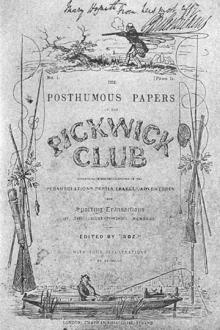
ffecting Interview between Mr. Samuel Weller and a Family Party. Mr. Pickwick makes a Tour of the diminutive World he inhabits, and resolves to mix with it, in Future, as little as possible
46. Records a touching Act of delicate Feeling not unmixed with Pleasantry, achieved and performed by Messrs. Dodson and Fogg
47. Is chiefly devoted to Matters of Business, and the temporal Advantage of Dodson and Fogg-- Mr. Winkle reappears under extraordinary Circumstances--Mr. Pickwick's Benevolence proves stronger than his Obstinacy
48. Relates how Mr. Pickwick, with the Assistance of Samuel Weller, essayed to soften the Heart of Mr. Benjamin Allen, and to mollify the Wrath of Mr. Robert Sawyer
49. Containing the Story of the Bagman's Uncle
50. How Mr. Pickwick sped upon his Mission, and how he was reinforced in the Outset by a most unexpected Auxiliary
51. In which Mr. Pickwick encounters an old Acquaintance--To which fortunate Circumstance the Reader is mainly indebted for Ma

had ever beheld, that lovely modesty with which she received him, that softness in her look and sighs, upon the melancholy occasion of this honor that was done by so great a man as Oroonoko, and a prince of whom she had heard such admirable things; the awfulness wherewith she received him, and the sweetness of her words and behavior while he staid, gained a perfect conquest over his fierce heart, and made him feel the victor could be subdued. So that having made his first compliments, and presented her an hundred and fifty slaves in fetters, he told her with his eyes that he was not insensible of her charms; while Imoinda, who wished for nothing more than so glorious a conquest, was pleased to believe she understood that silent language of new-born love; and, from that moment, put on all her additions to beauty.
The prince returned to court with quite another humor than before; and though he did not speak much of the fair Imoinda, he had the pleasure to hear all his followers speak of nothing but the

there was a heavy element of risk involved. Three teams of recruits--the Eskimos from Point Barren, the Apaches, and the Islanders--all picked because their people had a high survival rating in the past, to be colonists on widely different types of planets. Well, the Eskimos and the Islanders aren't matched to any of the worlds on those snooped tapes, but Topaz is waiting for the Apaches. And we may have to move them in there in a hurry. It's a rotten gamble any way you see it!"
"I'll appeal directly to the council."
Kelgarries shrugged. "All right. You have my backing."
"But you believe such an effort hopeless?"
"You know the red-tape merchants. You'll have to move fast if you want to beat Ruthven. He's probably on a straight line now to Stanton, Reese, and Margate. This is what he has been waiting for!"
"There are the news syndicates; public opinion would back us----"
"You don't mean that, of course." Kelgarries was suddenly coldly remote.
Ashe flushed under

e had finished he would look out across the cultivated lands where the mission Kaffirs had their huts.
But I knew it was not these he saw, but rather the grey English church, and the graves ranged side by side before the yew near the wicket gate.
It was there on the stoep that he died. He had not been well, and one evening I was talking to him, and his mind went back to Oxfordshire and my mother. He spoke of her a good deal, saying that she had never been out of his mind for a single day during all these years, and that he rejoiced to think he was drawing near that land wither she had gone. Then he asked me if I remembered the night when Squire Carson came into the study at the vicarage, and told him that his wife had run away, and that he was going to change his name and bury himself in some remote land.
I answered that I remembered it perfectly.
"I wonder where he went to," said my father, "and if he and his daughter Stella are still alive. Well, well! I shall never meet them aga

in a mysterious way," commonly with the property of another.
Spring beckons! All things to the call respond; The trees are leaving and cashiers abscond.
Phela Orm
ABSENT, adj. Peculiarly exposed to the tooth of detraction; vilifed; hopelessly in the wrong; superseded in the consideration and affection of another.
To men a man is but a mind. Who cares What face he carries or what form he wears? But woman's body is the woman. O, Stay thou, my sweetheart, and do never go, But heed the warning words the sage hath said: A woman absent is a woman dead.
Jogo Tyree
ABSENTEE, n. A person with an income who has had the forethought to remove himself from the sphere of exaction.
ABSOLUTE, adj. Independent, irresponsible. An absolute monarchy is one in which the sovereign does as he pleases so long as he pleases the assassins. Not many absolute monarchies are left, most of them having been replaced by limited monarchies, where the sovereign's power for evil (and for good) i

They came up a natural seven and Jason smiled.
When he scooped them up the smile slowly faded. The dice were transparent, finely made, evenly weighted on all sides--and crooked.
The pigment on the dots of five sides of each die was some heavy metal compound, probably lead. The sixth side was a ferrous compound. They would roll true unless they hit a magnetic field--that meant the entire surface of the table could be magnetized. He could never have spotted the difference if he hadn't looked at the dice with his mind. But what could he do about it?
Shaking them slowly he glanced quickly around the table. There was what he needed. An ashtray with a magnet in its base to hold it to the metal edge of the table. Jason stopped shaking the dice and looked at them quizzically, then reached over and grabbed the ashtray. He dropped the base against his hand.
As he lifted the ashtray there was a concerted gasp from all sides. The dice were sticking there, upside down, box cars showin

th five brilliants in it. Dorothea immediately took up the necklace and fastened it round her sister's neck, where it fitted almost as closely as a bracelet; but the circle suited the Henrietta-Maria style of Celia's head and neck, and she could see that it did, in the pier-glass opposite.
"There, Celia! you can wear that with your Indian muslin. But this cross you must wear with your dark dresses."
Celia was trying not to smile with pleasure. "O Dodo, you must keep the cross yourself."
"No, no, dear, no," said Dorothea, putting up her hand with careless deprecation.
"Yes, indeed you must; it would suit you--in your black dress, now," said Celia, insistingly. "You might wear that."
"Not for the world, not for the world. A cross is the last thing I would wear as a trinket." Dorothea shuddered slightly.
"Then you will think it wicked in me to wear it," said Celia, uneasily.
"No, dear, no," said Dorothea, stroking her sister's cheek. "Souls have complexio

ring their emotional set and stock of ideas, by sharing in what the elders are doing. In part, this sharing is direct, taking part in the occupations of adults and thus serving an apprenticeship; in part, it is indirect, through the dramatic plays in which children reproduce the actions of grown-ups and thus learn to know what they are like. To savages it would seem preposterous to seek out a place where nothing but learning was going on in order that one might learn.
But as civilization advances, the gap between the capacities of the young and the concerns of adults widens. Learning by direct sharing in the pursuits of grown-ups becomes increasingly difficult except in the case of the less advanced occupations. Much of what adults do is so remote in space and in meaning that playful imitation is less and less adequate to reproduce its spirit. Ability to share effectively in adult activities thus depends upon a prior training given with this end in view. Intentional agencies -- schools--and explicit ma
ele-1983, but external conditions caused the `temporary' freeze to become permanent.
The AI Lab culture had been hit hard in the late 1970s by funding cuts and the resulting administrative decision to use vendor-supported hardware and software instead of homebrew whenever possible. At MIT, most AI work had turned to dedicated LISP Machines. At the same time, the commercialization of AI technology lured some of the AI Lab's best and brightest away to startups along the Route 128 strip in Massachusetts and out West in Silicon Valley. The startups built LISP machines for MIT; the central MIT-AI computer became a [45]TWENEX system rather than a host for the AI hackers' beloved [46]ITS.
The Stanford AI Lab had effectively ceased to exist by 1980, although the SAIL computer continued as a Computer Science Department resource until 1991. Stanford became a major [47]TWENEX site, at one point operating more than a dozen TOPS-20 systems; but by the mid-1980s most of the interesting software work was being
e springing back, when released, to its original position and shape. This gift naturally delighted the two lads immensely.
At length their final orders came, bidding them be on board by the 20th of July, without fail, as the ship and fleet sailed on the 21st at daybreak.
Roger and Harry accordingly packed their belongings, and, girding on their new swords, started down the river early the next day, accompanied by Roger's parents and Harry's sister, all of whom were anxious to see as much of the two lads as possible before they left.
They all arrived in Plymouth in the afternoon, and the lads having reported themselves, and formally joined their ship, the entire party proceeded to Harry's house to spend the night.
They all rose in the early hours of the next morning, and the last farewells were said upon the quay, while the boat from the Stag Royal remained alongside to convey them to the ship. Roger's mother wept copiously, and fervently prayed that her son might return sa
ffecting Interview between Mr. Samuel Weller and a Family Party. Mr. Pickwick makes a Tour of the diminutive World he inhabits, and resolves to mix with it, in Future, as little as possible
46. Records a touching Act of delicate Feeling not unmixed with Pleasantry, achieved and performed by Messrs. Dodson and Fogg
47. Is chiefly devoted to Matters of Business, and the temporal Advantage of Dodson and Fogg-- Mr. Winkle reappears under extraordinary Circumstances--Mr. Pickwick's Benevolence proves stronger than his Obstinacy
48. Relates how Mr. Pickwick, with the Assistance of Samuel Weller, essayed to soften the Heart of Mr. Benjamin Allen, and to mollify the Wrath of Mr. Robert Sawyer
49. Containing the Story of the Bagman's Uncle
50. How Mr. Pickwick sped upon his Mission, and how he was reinforced in the Outset by a most unexpected Auxiliary
51. In which Mr. Pickwick encounters an old Acquaintance--To which fortunate Circumstance the Reader is mainly indebted for Ma
had ever beheld, that lovely modesty with which she received him, that softness in her look and sighs, upon the melancholy occasion of this honor that was done by so great a man as Oroonoko, and a prince of whom she had heard such admirable things; the awfulness wherewith she received him, and the sweetness of her words and behavior while he staid, gained a perfect conquest over his fierce heart, and made him feel the victor could be subdued. So that having made his first compliments, and presented her an hundred and fifty slaves in fetters, he told her with his eyes that he was not insensible of her charms; while Imoinda, who wished for nothing more than so glorious a conquest, was pleased to believe she understood that silent language of new-born love; and, from that moment, put on all her additions to beauty.
The prince returned to court with quite another humor than before; and though he did not speak much of the fair Imoinda, he had the pleasure to hear all his followers speak of nothing but the
there was a heavy element of risk involved. Three teams of recruits--the Eskimos from Point Barren, the Apaches, and the Islanders--all picked because their people had a high survival rating in the past, to be colonists on widely different types of planets. Well, the Eskimos and the Islanders aren't matched to any of the worlds on those snooped tapes, but Topaz is waiting for the Apaches. And we may have to move them in there in a hurry. It's a rotten gamble any way you see it!"
"I'll appeal directly to the council."
Kelgarries shrugged. "All right. You have my backing."
"But you believe such an effort hopeless?"
"You know the red-tape merchants. You'll have to move fast if you want to beat Ruthven. He's probably on a straight line now to Stanton, Reese, and Margate. This is what he has been waiting for!"
"There are the news syndicates; public opinion would back us----"
"You don't mean that, of course." Kelgarries was suddenly coldly remote.
Ashe flushed under
e had finished he would look out across the cultivated lands where the mission Kaffirs had their huts.
But I knew it was not these he saw, but rather the grey English church, and the graves ranged side by side before the yew near the wicket gate.
It was there on the stoep that he died. He had not been well, and one evening I was talking to him, and his mind went back to Oxfordshire and my mother. He spoke of her a good deal, saying that she had never been out of his mind for a single day during all these years, and that he rejoiced to think he was drawing near that land wither she had gone. Then he asked me if I remembered the night when Squire Carson came into the study at the vicarage, and told him that his wife had run away, and that he was going to change his name and bury himself in some remote land.
I answered that I remembered it perfectly.
"I wonder where he went to," said my father, "and if he and his daughter Stella are still alive. Well, well! I shall never meet them aga
in a mysterious way," commonly with the property of another.
Spring beckons! All things to the call respond; The trees are leaving and cashiers abscond.
Phela Orm
ABSENT, adj. Peculiarly exposed to the tooth of detraction; vilifed; hopelessly in the wrong; superseded in the consideration and affection of another.
To men a man is but a mind. Who cares What face he carries or what form he wears? But woman's body is the woman. O, Stay thou, my sweetheart, and do never go, But heed the warning words the sage hath said: A woman absent is a woman dead.
Jogo Tyree
ABSENTEE, n. A person with an income who has had the forethought to remove himself from the sphere of exaction.
ABSOLUTE, adj. Independent, irresponsible. An absolute monarchy is one in which the sovereign does as he pleases so long as he pleases the assassins. Not many absolute monarchies are left, most of them having been replaced by limited monarchies, where the sovereign's power for evil (and for good) i
They came up a natural seven and Jason smiled.
When he scooped them up the smile slowly faded. The dice were transparent, finely made, evenly weighted on all sides--and crooked.
The pigment on the dots of five sides of each die was some heavy metal compound, probably lead. The sixth side was a ferrous compound. They would roll true unless they hit a magnetic field--that meant the entire surface of the table could be magnetized. He could never have spotted the difference if he hadn't looked at the dice with his mind. But what could he do about it?
Shaking them slowly he glanced quickly around the table. There was what he needed. An ashtray with a magnet in its base to hold it to the metal edge of the table. Jason stopped shaking the dice and looked at them quizzically, then reached over and grabbed the ashtray. He dropped the base against his hand.
As he lifted the ashtray there was a concerted gasp from all sides. The dice were sticking there, upside down, box cars showin
th five brilliants in it. Dorothea immediately took up the necklace and fastened it round her sister's neck, where it fitted almost as closely as a bracelet; but the circle suited the Henrietta-Maria style of Celia's head and neck, and she could see that it did, in the pier-glass opposite.
"There, Celia! you can wear that with your Indian muslin. But this cross you must wear with your dark dresses."
Celia was trying not to smile with pleasure. "O Dodo, you must keep the cross yourself."
"No, no, dear, no," said Dorothea, putting up her hand with careless deprecation.
"Yes, indeed you must; it would suit you--in your black dress, now," said Celia, insistingly. "You might wear that."
"Not for the world, not for the world. A cross is the last thing I would wear as a trinket." Dorothea shuddered slightly.
"Then you will think it wicked in me to wear it," said Celia, uneasily.
"No, dear, no," said Dorothea, stroking her sister's cheek. "Souls have complexio
ring their emotional set and stock of ideas, by sharing in what the elders are doing. In part, this sharing is direct, taking part in the occupations of adults and thus serving an apprenticeship; in part, it is indirect, through the dramatic plays in which children reproduce the actions of grown-ups and thus learn to know what they are like. To savages it would seem preposterous to seek out a place where nothing but learning was going on in order that one might learn.
But as civilization advances, the gap between the capacities of the young and the concerns of adults widens. Learning by direct sharing in the pursuits of grown-ups becomes increasingly difficult except in the case of the less advanced occupations. Much of what adults do is so remote in space and in meaning that playful imitation is less and less adequate to reproduce its spirit. Ability to share effectively in adult activities thus depends upon a prior training given with this end in view. Intentional agencies -- schools--and explicit ma