
1:28 And God blessed them, and God said unto them, Be fruitful, and multiply, and replenish the earth, and subdue it: and have dominion over the fish of the sea, and over the fowl of the air, and over every living thing that moveth upon the earth.
1:29 And God said, Behold, I have given you every herb bearing seed, which is upon the face of all the earth, and every tree, in the which is the fruit of a tree yielding seed; to you it shall be for meat.
1:30 And to every beast of the earth, and to every fowl of the air, and to every thing that creepeth upon the earth, wherein there is life, I have given every green herb for meat: and it was so.
1:31 And God saw every thing that he had made, and, behold, it was very good. And the evening and the morning were the sixth day.
Genesis Chapter 2
2:1 Thus the heavens and the earth were finished, and all the host of them.
2:2 And on the seventh day God ended his work which he had made; and he rested on the seventh day from all his work which he had made.
2:3 And God blessed the seventh day, and sanctified it: because that in it he had rested fro

chanic. The editor of a newspaper was always a printer and often composed his articles as he set them in type; so "composing" came to mean typesetting, and one who sets type is a compositor. Now James needed an apprentice. It happened then that young Benjamin, at the age of thirteen, was bound over by law to serve his brother.
James Franklin printed the "New England Courant", the fourth newspaper to be established in the colonies. Benjamin soon began to write articles for this newspaper. Then when his brother was put in jail, because he had printed matter considered libelous, and forbidden to continue as the publisher, the newspaper appeared in Benjamin's name.
The young apprentice felt that his brother was unduly severe and, after serving for about two years, made up his mind to run away. Secretly he took passage on a sloop and in three days reached New York, there to find that the one printer in the town, William Bradford, could give him no work. Benjamin then set out for Philadelphia. By boat

1. ... K-Q3
2. P-B3 K-B3
3. K-B4 and wins.
This settles all typical end-games of King and pawn against King. There is, however, one exception to the rules set out, namely, when a ROOK'S PAWN is concerned. Here the isolated King always succeeds in drawing if he can reach the corner where the pawn has to queen, for he cannot be driven out again. The Rook's pawn affords another opportunity for the weaker side to draw. Diagram 55 will illustrate this, and similar positions are of frequent occurrence in practice. Here Black draws with 1. ... K-B5. As he threatens to capture the pawn, White must play 2. P-R4. Then after the reply K-B4, White is still unable to cut the opponent off from the corner with K-Kt7, as the loss of the pawn is still threatened through K-Kt5. And after 3. P-R5 Black attains the position which is typical for this end-game, namely the opposition against the King on the Rook's file. The latter cannot escape without giving up the contested corner, and the game is drawn. 3. ... K-B3; 4. K-R7, K-B2; 5. K-R8, K-B1; 6. P-R6, K-B2; 7. P-R7, K-B1: and White is stalemated.
Diag. 55
object that causeth them, but so many several motions of the matter, by which it presseth our organs diversly. Neither in us that are pressed, are they anything els, but divers motions; (for motion, produceth nothing but motion.) But their apparence to us is Fancy, the same waking, that dreaming. And as pressing, rubbing, or striking the Eye, makes us fancy a light; and pressing the Eare, produceth a dinne; so do the bodies also we see, or hear, produce the same by their strong, though unobserved action, For if those Colours, and Sounds, were in the Bodies, or Objects that cause them, they could not bee severed from them, as by glasses, and in Ecchoes by reflection, wee see they are; where we know the thing we see, is in one place; the apparence, in another. And though at some certain distance, the reall, and very object seem invested with the fancy it begets in us; Yet still the object is one thing, the image or fancy is another. So that Sense in all cases, is nothing els but originall fancy, caused (as I h

thin a tiny oasis. Close by was an Arab douar of some eight or ten tents.
I had come down from the north to hunt lion. My party consisted of a dozen children of the desert--I was the only "white" man. As we approached the little clump of verdure I saw the man come from his tent and with hand-shaded eyes peer intently at us. At sight of me he advanced rapidly to meet us.
"A white man!" he cried. "May the good Lord be praised! I have been watching you for hours, hoping against hope that THIS time there would be a white man. Tell me the date. What year is it?"
And when I had told him he staggered as though he had been struck full in the face, so that he was compelled to grasp my stirrup leather for support.
"It cannot be!" he cried after a moment. "It cannot be! Tell me that you are mistaken, or that you are but joking."
"I am telling you the truth, my friend," I replied. "Why should I deceive a stranger, or attempt to, in so simple a matter as the date?"
For some time h
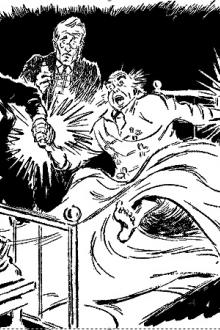
Professor Carbonic was diligently at work in his spacious laboratory, analyzing, mixing and experimenting. He had been employed for more than fifteen years in the same pursuit of happiness, in the same house, same laboratory, and attended by the same servant woman, who in her long period of service had attained the plumpness and respectability of two hundred and ninety pounds.
[Illustration: The electric current lighted up everything in sight!]
"Mag Nesia," called the professor. The servant's name was Maggie Nesia--Professor Carbonic had contracted the title to save time, for in fifteen years he had not mounted the heights of greatness; he must work harder and faster as life is short, and eliminate such shameful waste of time as putting the "gie" on Maggie.
"Mag Nesia!" the professor repeated.
The old woman rolled slowly into the room.
"Get
y the sea.
CATHLEENHow would they be Michael's, Nora. How would he go the lengthof that way to the far north?
NORAThe young priest says he's known the like of it. "If it'sMichael's they are," says he, "you can tell herself he's got aclean burial by the grace of God, and if they're not his, letno one say a word about them, for she'll be getting her death,"says he, "with crying and lamenting."
[The door which Nora half closed is blown open by a gust ofwind.]
CATHLEEN[Looking out anxiously.]
Did you ask him would he stop Bartley going this day with thehorses to the Galway fair?
NORA"I won't stop him," says he, "but let you not be afraid.Herself does be saying prayers half through the night, and theAlmighty God won't leave her destitute," says he, "with no sonliving."
CATHLEENIs the sea bad by the white rocks, Nora?
NORAMiddling bad, God help us. There's a great roaring in thewest, and it's worse it'll be getting when the tide's turned tothe wind.
[She goes over to

ue of a pretended secret marriage between Charles Stuart and Lucy Walter - it was possible that this Monmouth who now proclaimed himself King of England was not even the illegitimate child of the late sovereign. What but ruin and disaster could be the end of this grotesque pretension? How could it be hoped that England would ever swallow such a Perkin? And it was on his behalf, to uphold his fantastic claim, that these West Country clods, led by a few armigerous Whigs, had been seduced into rebellion!
"Quo, quo, scelesti, ruitis?"
He laughed and sighed in one; but the laugh dominated the sigh, for Mr. Blood was unsympathetic, as are most self-sufficient men; and he was very self-sufficient; adversity had taught him so to be. A more tender-hearted man, possessing his vision and his knowledge, might have found cause for tears in the contemplation of these ardent, simple, Nonconformist sheep going forth to the shambles - escorted to the rallying ground on Castle Field by wives and daughters, sweeth

, would have been in the alley by now, forcing a full confession from whoever was skulking in the shadows. Pity the fellow caught by her fierce questions. But Maggie was not Pat, and Pat was far away in Cryneth. She kept walking.
"Maggie Sheffield?" It was a trembling voice, old, and strangely familiar. It was deep with illness.
Maggie turned slowly to see a small, hunched old man step out from the shadows. He stood silhouetted against the fence, and Maggie could not see his face or his features. He stretched out a hand toward her. It was shaking.
"Maggie?" he asked again. He took a step forward and Maggie realized that he was about to fall. She dropped the leafy twigs in her hand and rushed forward, grabbing the old man's arm to steady him. He looked up at her with weary, gray eyes.
"Thank ye, Maggie," he said.
She knew who he was. The relief of recognition flooded her. Those gray eyes had regarded her kindly when she was a child in the Orphan House, and once they had watch

ng fallow, and even undiscovered in many instances. Americans had begun, it is true, to exploit their more obvious, external wealth, their forests and their land; the first had made them one of the world's two greatest shipbuilding nations, while the second had furnished a large part of the resources that had enabled the Federal Government to fight what was, up to that time, the greatest war in history. But the extensive prairie plains whose settlement was to follow the railroad extensions of the sixties and the seventies--Kansas, Nebraska, Iowa, Oklahoma, Minnesota, the Dakotas--had been only slightly penetrated. This region, with a rainfall not too abundant and not too scanty, with a cultivable soil extending from eight inches to twenty feet under the ground, with hardly a rock in its whole extent, with scarcely a tree, except where it bordered on the streams, has been pronounced by competent scientists the finest farming country to which man has ever set the plow. Our mineral wealth was likewise lying ever
1:28 And God blessed them, and God said unto them, Be fruitful, and multiply, and replenish the earth, and subdue it: and have dominion over the fish of the sea, and over the fowl of the air, and over every living thing that moveth upon the earth.
1:29 And God said, Behold, I have given you every herb bearing seed, which is upon the face of all the earth, and every tree, in the which is the fruit of a tree yielding seed; to you it shall be for meat.
1:30 And to every beast of the earth, and to every fowl of the air, and to every thing that creepeth upon the earth, wherein there is life, I have given every green herb for meat: and it was so.
1:31 And God saw every thing that he had made, and, behold, it was very good. And the evening and the morning were the sixth day.
Genesis Chapter 2
2:1 Thus the heavens and the earth were finished, and all the host of them.
2:2 And on the seventh day God ended his work which he had made; and he rested on the seventh day from all his work which he had made.
2:3 And God blessed the seventh day, and sanctified it: because that in it he had rested fro
chanic. The editor of a newspaper was always a printer and often composed his articles as he set them in type; so "composing" came to mean typesetting, and one who sets type is a compositor. Now James needed an apprentice. It happened then that young Benjamin, at the age of thirteen, was bound over by law to serve his brother.
James Franklin printed the "New England Courant", the fourth newspaper to be established in the colonies. Benjamin soon began to write articles for this newspaper. Then when his brother was put in jail, because he had printed matter considered libelous, and forbidden to continue as the publisher, the newspaper appeared in Benjamin's name.
The young apprentice felt that his brother was unduly severe and, after serving for about two years, made up his mind to run away. Secretly he took passage on a sloop and in three days reached New York, there to find that the one printer in the town, William Bradford, could give him no work. Benjamin then set out for Philadelphia. By boat
1. ... K-Q3
2. P-B3 K-B3
3. K-B4 and wins.
This settles all typical end-games of King and pawn against King. There is, however, one exception to the rules set out, namely, when a ROOK'S PAWN is concerned. Here the isolated King always succeeds in drawing if he can reach the corner where the pawn has to queen, for he cannot be driven out again. The Rook's pawn affords another opportunity for the weaker side to draw. Diagram 55 will illustrate this, and similar positions are of frequent occurrence in practice. Here Black draws with 1. ... K-B5. As he threatens to capture the pawn, White must play 2. P-R4. Then after the reply K-B4, White is still unable to cut the opponent off from the corner with K-Kt7, as the loss of the pawn is still threatened through K-Kt5. And after 3. P-R5 Black attains the position which is typical for this end-game, namely the opposition against the King on the Rook's file. The latter cannot escape without giving up the contested corner, and the game is drawn. 3. ... K-B3; 4. K-R7, K-B2; 5. K-R8, K-B1; 6. P-R6, K-B2; 7. P-R7, K-B1: and White is stalemated.
Diag. 55
object that causeth them, but so many several motions of the matter, by which it presseth our organs diversly. Neither in us that are pressed, are they anything els, but divers motions; (for motion, produceth nothing but motion.) But their apparence to us is Fancy, the same waking, that dreaming. And as pressing, rubbing, or striking the Eye, makes us fancy a light; and pressing the Eare, produceth a dinne; so do the bodies also we see, or hear, produce the same by their strong, though unobserved action, For if those Colours, and Sounds, were in the Bodies, or Objects that cause them, they could not bee severed from them, as by glasses, and in Ecchoes by reflection, wee see they are; where we know the thing we see, is in one place; the apparence, in another. And though at some certain distance, the reall, and very object seem invested with the fancy it begets in us; Yet still the object is one thing, the image or fancy is another. So that Sense in all cases, is nothing els but originall fancy, caused (as I h
thin a tiny oasis. Close by was an Arab douar of some eight or ten tents.
I had come down from the north to hunt lion. My party consisted of a dozen children of the desert--I was the only "white" man. As we approached the little clump of verdure I saw the man come from his tent and with hand-shaded eyes peer intently at us. At sight of me he advanced rapidly to meet us.
"A white man!" he cried. "May the good Lord be praised! I have been watching you for hours, hoping against hope that THIS time there would be a white man. Tell me the date. What year is it?"
And when I had told him he staggered as though he had been struck full in the face, so that he was compelled to grasp my stirrup leather for support.
"It cannot be!" he cried after a moment. "It cannot be! Tell me that you are mistaken, or that you are but joking."
"I am telling you the truth, my friend," I replied. "Why should I deceive a stranger, or attempt to, in so simple a matter as the date?"
For some time h
Professor Carbonic was diligently at work in his spacious laboratory, analyzing, mixing and experimenting. He had been employed for more than fifteen years in the same pursuit of happiness, in the same house, same laboratory, and attended by the same servant woman, who in her long period of service had attained the plumpness and respectability of two hundred and ninety pounds.
[Illustration: The electric current lighted up everything in sight!]
"Mag Nesia," called the professor. The servant's name was Maggie Nesia--Professor Carbonic had contracted the title to save time, for in fifteen years he had not mounted the heights of greatness; he must work harder and faster as life is short, and eliminate such shameful waste of time as putting the "gie" on Maggie.
"Mag Nesia!" the professor repeated.
The old woman rolled slowly into the room.
"Get
y the sea.
CATHLEENHow would they be Michael's, Nora. How would he go the lengthof that way to the far north?
NORAThe young priest says he's known the like of it. "If it'sMichael's they are," says he, "you can tell herself he's got aclean burial by the grace of God, and if they're not his, letno one say a word about them, for she'll be getting her death,"says he, "with crying and lamenting."
[The door which Nora half closed is blown open by a gust ofwind.]
CATHLEEN[Looking out anxiously.]
Did you ask him would he stop Bartley going this day with thehorses to the Galway fair?
NORA"I won't stop him," says he, "but let you not be afraid.Herself does be saying prayers half through the night, and theAlmighty God won't leave her destitute," says he, "with no sonliving."
CATHLEENIs the sea bad by the white rocks, Nora?
NORAMiddling bad, God help us. There's a great roaring in thewest, and it's worse it'll be getting when the tide's turned tothe wind.
[She goes over to
ue of a pretended secret marriage between Charles Stuart and Lucy Walter - it was possible that this Monmouth who now proclaimed himself King of England was not even the illegitimate child of the late sovereign. What but ruin and disaster could be the end of this grotesque pretension? How could it be hoped that England would ever swallow such a Perkin? And it was on his behalf, to uphold his fantastic claim, that these West Country clods, led by a few armigerous Whigs, had been seduced into rebellion!
"Quo, quo, scelesti, ruitis?"
He laughed and sighed in one; but the laugh dominated the sigh, for Mr. Blood was unsympathetic, as are most self-sufficient men; and he was very self-sufficient; adversity had taught him so to be. A more tender-hearted man, possessing his vision and his knowledge, might have found cause for tears in the contemplation of these ardent, simple, Nonconformist sheep going forth to the shambles - escorted to the rallying ground on Castle Field by wives and daughters, sweeth
, would have been in the alley by now, forcing a full confession from whoever was skulking in the shadows. Pity the fellow caught by her fierce questions. But Maggie was not Pat, and Pat was far away in Cryneth. She kept walking.
"Maggie Sheffield?" It was a trembling voice, old, and strangely familiar. It was deep with illness.
Maggie turned slowly to see a small, hunched old man step out from the shadows. He stood silhouetted against the fence, and Maggie could not see his face or his features. He stretched out a hand toward her. It was shaking.
"Maggie?" he asked again. He took a step forward and Maggie realized that he was about to fall. She dropped the leafy twigs in her hand and rushed forward, grabbing the old man's arm to steady him. He looked up at her with weary, gray eyes.
"Thank ye, Maggie," he said.
She knew who he was. The relief of recognition flooded her. Those gray eyes had regarded her kindly when she was a child in the Orphan House, and once they had watch
ng fallow, and even undiscovered in many instances. Americans had begun, it is true, to exploit their more obvious, external wealth, their forests and their land; the first had made them one of the world's two greatest shipbuilding nations, while the second had furnished a large part of the resources that had enabled the Federal Government to fight what was, up to that time, the greatest war in history. But the extensive prairie plains whose settlement was to follow the railroad extensions of the sixties and the seventies--Kansas, Nebraska, Iowa, Oklahoma, Minnesota, the Dakotas--had been only slightly penetrated. This region, with a rainfall not too abundant and not too scanty, with a cultivable soil extending from eight inches to twenty feet under the ground, with hardly a rock in its whole extent, with scarcely a tree, except where it bordered on the streams, has been pronounced by competent scientists the finest farming country to which man has ever set the plow. Our mineral wealth was likewise lying ever