
.
Gurney: What was the face value of the policy?
Gorham: One thousand dollars.
Gurney: Do you know how much money Morlock owed at the time of his wife's death?
Gorham: Certainly not.
Gurney: But you do know that he was heavily in debt and that he was being hounded by his creditors.
* * *
The Commonwealth of Massachusetts vs. Alvin Morlock. Direct testimony of George Gorham.
It was only half-past two when Morlock stopped in front of the immaculately gleaming facade of the appliance store. Embarrassment and shame waited for him in the building, and he hesitated before he entered. He had been here once before when Lolly had picked out a television set and a refrigerator and a stove. In that order, he remembered wryly. And the largest television set, the smallest refrigerator and stove.
He shook his head silently at the clerk who came to meet him and walked toward the back of the store where a green neon script sign marked the credit departme

THE HOUSE OF FAME
TROILUS AND CRESSIDA
CHAUCER'S DREAM [1]
THE PROLOGUE TO THE LEGEND OF GOOD WOMEN
CHAUCER'S A.B.C.
MISCELLANEOUS POEMS
Transcriber's Note.
- Modern scholars believe that Chaucer was not the author ofthese poems.
PREFACE.
THE object of this volume is to place before the general readerour two early poetic masterpieces -- The Canterbury Tales andThe Faerie Queen; to do so in a way that will render their"popular perusal" easy in a time of little leisure and unboundedtemptations to intellectual languor; and, on the same conditions,to present a liberal and fairly representative selection from theless important and familiar poems of Chaucer and Spenser.There is, it may be said at the outset, peculiar advantage andpropriety in placing the two poets side by side in the mannernow attempted for the first time. Although two

person who stayed in our house whom we called the captain.
"Well," said he, "my mate Bill would be called the captain, as like as not. He has a cut on one cheek and a mighty pleasant way with him, particularly in drink, has my mate Bill. We'll put it, for argument like, that your captain has a cut on one cheek--and we'll put it, if you like, that that cheek's the right one. Ah, well! I told you. Now, is my mate Bill in this here house?"
I told him he was out walking.
"Which way, sonny? Which way is he gone?"
And when I had pointed out the rock and told him how the captain was likely to return, and how soon, and answered a few other questions, "Ah," said he, "this'll be as good as drink to my mate Bill."
The expression of his face as he said these words was not at all pleasant, and I had my own reasons for thinking that the stranger was mistaken, even supposing he meant what he said. But it was no affair of mine, I thought; and besides, it was difficult to know what to do. Th

a skeleton frame. His eyes are so deep that you can hardly see the fixed pupils. You just see two big black holes, as in a dead man's skull. His skin, which is stretched across his bones like a drumhead, is not white, but a nasty yellow. His nose is so little worth talking about that you can't see it side-face; and THE ABSENCE of that nose is a horrible thing TO LOOK AT. All the hair he has is three or four long dark locks on his forehead and behind his ears."
This chief scene-shifter was a serious, sober, steady man, very slow at imagining things. His words were received with interest and amazement; and soon there were other people to say that they too had met a man in dress-clothes with a death's head on his shoulders. Sensible men who had wind of the story began by saying that Joseph Buquet had been the victim of a joke played by one of his assistants. And then, one after the other, there came a series of incidents so curious and so inexplicable that the very shrewdest people began to feel uneasy.

facial muscles.
Constant repetition of the same kinds of thoughts or emotions finally makes permanent changes in that part of the body which is physiologically related to these mental processes.
The Evolution of the Jaw
¶ The jaw is a good illustration of this alliance between the mind and the body. Its muscles and bones are so closely allied to the pugnacity instinct center in the brain that the slightest thought of combat causes the jaw muscles to stiffen. Let the thought of any actual physical encounter go through your mind and your jaw bone will automatically move upward and outward.
After a lifetime of combat, whether by fists or words, the jaw sets permanently a little more upward and outward--a little more like that of the bulldog. It keeps to this combative mold, "because," says Mother Nature, the great efficiency expert, "if you are going to call on me constantly to stiffen that jaw I'll fix it so it will stay that way and save myself the trouble."
Inheritance
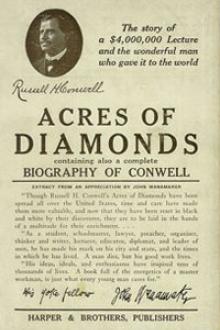
onderful world of ours. If this internalmolten mass came bursting out and cooled veryquickly it became granite; less quickly copper,less quickly silver, less quickly gold, and, aftergold, diamonds were made.
Said the old priest, ``A diamond is a congealeddrop of sunlight.'' Now that is literally scientificallytrue, that a diamond is an actual depositof carbon from the sun. The old priest told AliHafed that if he had one diamond the size ofhis thumb he could purchase the county, and ifhe had a mine of diamonds he could place hischildren upon thrones through the influence oftheir great wealth.
Ali Hafed heard all about diamonds, how muchthey were worth, and went to his bed that nighta poor man. He had not lost anything, but hewas poor because he was discontented, anddiscontented because he feared he was poor. Hesaid, ``I want a mine of diamonds,'' and he layawake all night.
Early in the morning he sought out the priest.I know by experience that a priest is very crosswhen awake
unt of vapor for animals and vegetables to flourish.
5. Venus has the brightest lustre of our planets which is caused from enormous amount of vapor. It is carried over its orbit at about 67,000,000 miles from the sun, which requires 224 7/10 days to complete its course. Rotates once every 23 hours and 21 minutes. Diameter, 7,700 miles.
6. The earth is carried over its orbit; main distance being 93,000,000 miles from the sun, which requires one year to complete its course, which is 680,000,000 miles:
MILES Earth's diameter 8,000 Greater or equatorial 7,925 Less or polar 7,899 Difference on comparison 26
The earth rotates once every 23 hours, 56 minutes, and 4 seconds; has one satellite, which is carried over its orbit at a distance of 238,850 miles from the earth. Its diameter is 2,160 miles. The moon completes its orbit in 29 days, 12 hours, 44 minutes, and 2 seconds. Its currents touch the earth and cause the tide; also affects some plants of the phenomena verita; these plants are

pany them upstairs while he questioned her. In the absence of the coroner he wouldn't let the doctor touch the body.
"I must repair this lock," he said, "the first thing, so nothing can be disturbed."
Doctor Groom, a grim and dark man, had grown silent on entering the room. For a long time he stared at the body in the candle light, making as much of an examination as he could, evidently, without physical contact.
"Why did he ever come here to sleep?" he asked in his rumbling bass voice. "Nasty room! Unhealthy room! Ten to one you're a formality, policeman. Coroner's a formality."
He sneered a little.
"I daresay he died what the hard-headed world will call a natural death. Wonder what the coroner'll say."
The detective didn't answer. He shot rapid, uneasy glances about the room in which a single candle burned. After a time he said with an accent of complete conviction:
"That man was murdered."
Perhaps the doctor's significant words, added to her earlier d

study of words, phrases, and literary expressions is a highly interesting pursuit. There is a reciprocal influence between thought and language. What we think molds the words we use, and the words we use react upon our thoughts. Hence a study of words is a study of ideas, and a stimulant to deep and original thinking.
We should not, however, study "sparkling words and sonorous phrases" with the object of introducing them consciously into our speech. To do so would inevitably lead to stiltedness and superficiality. Words and phrases should be studied as symbols of ideas, and as we become thoroughly familiar with them they will play an unconscious but effective part in our daily expression.
We acquire our vocabulary largely from our reading and our personal associates. The words we use are an unmistakable indication of our thought habits, tastes, ideals, and interests in life. In like manner, the habitual language of a people is a barometer of their intellectual, civil, moral, and spiritual ideals

e end of her nose, while she counted "One, two, three" in a solemn voice. At once the cap changed to a slate, on which was written in big, white chalk marks:
"LET DOROTHY GO TO THE CITY OF EMERALDS"
The little old woman took the slate from her nose, and having read the words on it, asked, "Is your name Dorothy, my dear?"
"Yes," answered the child, looking up and drying her tears.
"Then you must go to the City of Emeralds. Perhaps Oz will help you."
"Where is this city?" asked Dorothy.
"It is exactly in the center of the country, and is ruled by Oz, the Great Wizard I told you of."
"Is he a good man?" inquired the girl anxiously.
"He is a good Wizard. Whether he is a man or not I cannot tell, for I have never seen him."
"How can I get there?" asked Dorothy.
"You must walk. It is a long journey, through a country that is sometimes pleasant and sometimes dark and terrible. However, I will use all the magic arts I know of to keep you from harm.
.
Gurney: What was the face value of the policy?
Gorham: One thousand dollars.
Gurney: Do you know how much money Morlock owed at the time of his wife's death?
Gorham: Certainly not.
Gurney: But you do know that he was heavily in debt and that he was being hounded by his creditors.
* * *
The Commonwealth of Massachusetts vs. Alvin Morlock. Direct testimony of George Gorham.
It was only half-past two when Morlock stopped in front of the immaculately gleaming facade of the appliance store. Embarrassment and shame waited for him in the building, and he hesitated before he entered. He had been here once before when Lolly had picked out a television set and a refrigerator and a stove. In that order, he remembered wryly. And the largest television set, the smallest refrigerator and stove.
He shook his head silently at the clerk who came to meet him and walked toward the back of the store where a green neon script sign marked the credit departme
THE HOUSE OF FAME
TROILUS AND CRESSIDA
CHAUCER'S DREAM [1]
THE PROLOGUE TO THE LEGEND OF GOOD WOMEN
CHAUCER'S A.B.C.
MISCELLANEOUS POEMS
Transcriber's Note.
- Modern scholars believe that Chaucer was not the author ofthese poems.
PREFACE.
THE object of this volume is to place before the general readerour two early poetic masterpieces -- The Canterbury Tales andThe Faerie Queen; to do so in a way that will render their"popular perusal" easy in a time of little leisure and unboundedtemptations to intellectual languor; and, on the same conditions,to present a liberal and fairly representative selection from theless important and familiar poems of Chaucer and Spenser.There is, it may be said at the outset, peculiar advantage andpropriety in placing the two poets side by side in the mannernow attempted for the first time. Although two
person who stayed in our house whom we called the captain.
"Well," said he, "my mate Bill would be called the captain, as like as not. He has a cut on one cheek and a mighty pleasant way with him, particularly in drink, has my mate Bill. We'll put it, for argument like, that your captain has a cut on one cheek--and we'll put it, if you like, that that cheek's the right one. Ah, well! I told you. Now, is my mate Bill in this here house?"
I told him he was out walking.
"Which way, sonny? Which way is he gone?"
And when I had pointed out the rock and told him how the captain was likely to return, and how soon, and answered a few other questions, "Ah," said he, "this'll be as good as drink to my mate Bill."
The expression of his face as he said these words was not at all pleasant, and I had my own reasons for thinking that the stranger was mistaken, even supposing he meant what he said. But it was no affair of mine, I thought; and besides, it was difficult to know what to do. Th
a skeleton frame. His eyes are so deep that you can hardly see the fixed pupils. You just see two big black holes, as in a dead man's skull. His skin, which is stretched across his bones like a drumhead, is not white, but a nasty yellow. His nose is so little worth talking about that you can't see it side-face; and THE ABSENCE of that nose is a horrible thing TO LOOK AT. All the hair he has is three or four long dark locks on his forehead and behind his ears."
This chief scene-shifter was a serious, sober, steady man, very slow at imagining things. His words were received with interest and amazement; and soon there were other people to say that they too had met a man in dress-clothes with a death's head on his shoulders. Sensible men who had wind of the story began by saying that Joseph Buquet had been the victim of a joke played by one of his assistants. And then, one after the other, there came a series of incidents so curious and so inexplicable that the very shrewdest people began to feel uneasy.
facial muscles.
Constant repetition of the same kinds of thoughts or emotions finally makes permanent changes in that part of the body which is physiologically related to these mental processes.
The Evolution of the Jaw
¶ The jaw is a good illustration of this alliance between the mind and the body. Its muscles and bones are so closely allied to the pugnacity instinct center in the brain that the slightest thought of combat causes the jaw muscles to stiffen. Let the thought of any actual physical encounter go through your mind and your jaw bone will automatically move upward and outward.
After a lifetime of combat, whether by fists or words, the jaw sets permanently a little more upward and outward--a little more like that of the bulldog. It keeps to this combative mold, "because," says Mother Nature, the great efficiency expert, "if you are going to call on me constantly to stiffen that jaw I'll fix it so it will stay that way and save myself the trouble."
Inheritance
onderful world of ours. If this internalmolten mass came bursting out and cooled veryquickly it became granite; less quickly copper,less quickly silver, less quickly gold, and, aftergold, diamonds were made.
Said the old priest, ``A diamond is a congealeddrop of sunlight.'' Now that is literally scientificallytrue, that a diamond is an actual depositof carbon from the sun. The old priest told AliHafed that if he had one diamond the size ofhis thumb he could purchase the county, and ifhe had a mine of diamonds he could place hischildren upon thrones through the influence oftheir great wealth.
Ali Hafed heard all about diamonds, how muchthey were worth, and went to his bed that nighta poor man. He had not lost anything, but hewas poor because he was discontented, anddiscontented because he feared he was poor. Hesaid, ``I want a mine of diamonds,'' and he layawake all night.
Early in the morning he sought out the priest.I know by experience that a priest is very crosswhen awake
unt of vapor for animals and vegetables to flourish.
5. Venus has the brightest lustre of our planets which is caused from enormous amount of vapor. It is carried over its orbit at about 67,000,000 miles from the sun, which requires 224 7/10 days to complete its course. Rotates once every 23 hours and 21 minutes. Diameter, 7,700 miles.
6. The earth is carried over its orbit; main distance being 93,000,000 miles from the sun, which requires one year to complete its course, which is 680,000,000 miles:
MILES Earth's diameter 8,000 Greater or equatorial 7,925 Less or polar 7,899 Difference on comparison 26
The earth rotates once every 23 hours, 56 minutes, and 4 seconds; has one satellite, which is carried over its orbit at a distance of 238,850 miles from the earth. Its diameter is 2,160 miles. The moon completes its orbit in 29 days, 12 hours, 44 minutes, and 2 seconds. Its currents touch the earth and cause the tide; also affects some plants of the phenomena verita; these plants are
pany them upstairs while he questioned her. In the absence of the coroner he wouldn't let the doctor touch the body.
"I must repair this lock," he said, "the first thing, so nothing can be disturbed."
Doctor Groom, a grim and dark man, had grown silent on entering the room. For a long time he stared at the body in the candle light, making as much of an examination as he could, evidently, without physical contact.
"Why did he ever come here to sleep?" he asked in his rumbling bass voice. "Nasty room! Unhealthy room! Ten to one you're a formality, policeman. Coroner's a formality."
He sneered a little.
"I daresay he died what the hard-headed world will call a natural death. Wonder what the coroner'll say."
The detective didn't answer. He shot rapid, uneasy glances about the room in which a single candle burned. After a time he said with an accent of complete conviction:
"That man was murdered."
Perhaps the doctor's significant words, added to her earlier d
study of words, phrases, and literary expressions is a highly interesting pursuit. There is a reciprocal influence between thought and language. What we think molds the words we use, and the words we use react upon our thoughts. Hence a study of words is a study of ideas, and a stimulant to deep and original thinking.
We should not, however, study "sparkling words and sonorous phrases" with the object of introducing them consciously into our speech. To do so would inevitably lead to stiltedness and superficiality. Words and phrases should be studied as symbols of ideas, and as we become thoroughly familiar with them they will play an unconscious but effective part in our daily expression.
We acquire our vocabulary largely from our reading and our personal associates. The words we use are an unmistakable indication of our thought habits, tastes, ideals, and interests in life. In like manner, the habitual language of a people is a barometer of their intellectual, civil, moral, and spiritual ideals
e end of her nose, while she counted "One, two, three" in a solemn voice. At once the cap changed to a slate, on which was written in big, white chalk marks:
"LET DOROTHY GO TO THE CITY OF EMERALDS"
The little old woman took the slate from her nose, and having read the words on it, asked, "Is your name Dorothy, my dear?"
"Yes," answered the child, looking up and drying her tears.
"Then you must go to the City of Emeralds. Perhaps Oz will help you."
"Where is this city?" asked Dorothy.
"It is exactly in the center of the country, and is ruled by Oz, the Great Wizard I told you of."
"Is he a good man?" inquired the girl anxiously.
"He is a good Wizard. Whether he is a man or not I cannot tell, for I have never seen him."
"How can I get there?" asked Dorothy.
"You must walk. It is a long journey, through a country that is sometimes pleasant and sometimes dark and terrible. However, I will use all the magic arts I know of to keep you from harm.