Genre Fiction. Page - 511

one assassin group,one palace,one girl
Jordan loved her, but where was he?
Swashbuckling pirate adventure gamebook. Can you survive being shipwrecked, return to civilisation and exact your revenge on your would be murderer?
when jacie jhonson a 12 year old girl goes on an adventure to find her dead fathers will but when she meets with a edge of a clif and could fall 1,000,000,000 feet above a 18 feet deep raging river what will happen next!
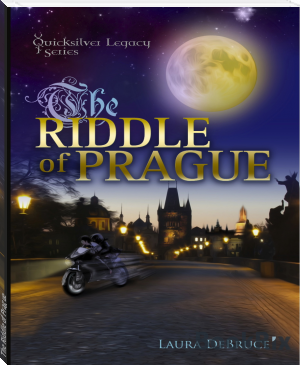
When 18-year-old Hana Silna travels to Prague to reclaim her family's ancestral home, she finds herself on an unexpected adventure in a city brimming with ancient secrets. She discovers a riddle by the infamous alchemist Edward Kelley that claims to lead to a long-last flask. The contents of that flask could change the fate of the world.
When a ruthless enemy kidnaps her family, Hana has to find the flask to rescue them. On her quest she meets a mysterious man with a penchant for poetry, a Gypsy girl with a haunting past, and Alex, the motorcycle-riding son of a U.S. diplomat. Alex -- who's trying to save his sister from a crippling disease -- joins Hana on her race across Bohemia to find the hidden flask. It's hard to trust anyone when the stakes are this high -- especially when surrounded by experts at deception.
There's only one flask and Hana desperately needs to find it.
The Riddle of Prague is the first of the Quicksilver Legacy Trilogy.

This is the story of all women who found themslvscaught in the men's selfish world.

Aurora Evalyn Warren is a physic. Hamon Brillicks is a angle. Milly Krils is a ghost. What could posiably happen next

A personal story about Daniel Topash (me; the author)
Scott Anderson is a disgruntled graduate student who prefers browsing through used bookstores to writing his dissertation. Scott always assumed that he would become a literature professor, but when a member of his committee criticizes his work, Scott is as angry and ashamed as any spurned lover, and he seeks out the pleasures of reading (as opposed to studying) books. One day he discovers a novel called Lesser Revolutions by a 1960s author he has never heard of named Richard Morton. Scott is so moved by Morton’s work that he decides to quit his Ph.D. program and to ask his father for a loan so he can write Morton’s biography.
The novel humorously intersperses chapters of Scott’s life with the life of Richard Morton as it shuffles together memoir with literary biography (both of which are fictional, in this case). Part of the humor comes from Scott’s inability to refrain from telling his own story while he tells Morton’s: all biographies, he insists, are really autobiographies. More of the humor comes from the fact that Morton really isn’t as good as Scott thinks he is: a self-centered alcoholic who abandons his family and who callously rejects love in favor of art, Morton comes across as a cad, and probably a cheap imitator of his literary hero, Jack Kerouac. Morton only managed to produce two novels and a handful of short stories, and he died obscurely at the age of 36. Still, Scott defends his subject as long as he can, realizing that he has staked his own career on Morton’s.
Scott, a native of Mason City, Iowa, moves to the wealthy coastal town of Marblehead, Massachusetts in order to research Morton’s life. Frustrated by his inability to discover anything about Morton by poking around the author’s native town, Scott is ready to give up when he stumbles across a woman named Sarah Taylor reading Lesser Revolutions on the beach. Sarah is unhappily married. She is beautiful and rich. And, Scott learns at an awkward moment, she is Richard Morton’s illegitimate daughter. She has taken pains to reinvent herself as a member of Marblehead’s upper-class yachting community, but she is clearly unfulfilled. Scott becomes her lover, and she becomes his unofficial patron as well as his editor, partly to control what he will say about the father who abandoned her and partly to give herself a sense of purpose.
The Great American Novelist involves a number of topics: the value of literary biography weighed against fiction, the cost of literary fame, the choice between career and family, and the difficulty outsiders face when they try to break into closed communities. Above all, though, it is a story about a romantic intellectual who believes in love and in fiction and a cynical socialite who won’t allow herself to believe in either. Having risked everything to write this biography and to pursue a life with Sarah, Scott learns that love doesn’t conquer all, at least not in Marblehead: money does. Still, he isn’t completely jaded by the end of the novel. He has grown up enough to lose some of his priggishness, but he has not completely given up on his original love: literature.
You, Me, and Your Three (full version) by Michael Graves (warren buffett book recommendations txt) 📖
When Jack married Emma, he knew what he was doing. She had three kids, she was older than him by nine years, and she had a psycho ex-husband. Nothing too out of the ordinary these days and certainly nothing he couldn't deal with. He had seen the face of crazy and he figured out how to handle it. The world is weird anyway and "normal" is an anachronism. But, it is only when you are living inside of a side show that you realize the humor in it is not as apparent without the proper distance from it.
If you have been married; If you have been in an abusive relationship; If you have gone through a divorce; If you have been re-married; If you have kids; If you have stepkids; If you have hired a contractor to build your home; If you have moved out of your first home after 20 years; If you have an alcoholic ex-spouse that vowed to kill you and teach your kids to hate you; If your kids have tried to throw away their lives in order to punish you; If you have been married to the most perfect person in the world; And, if you wouldn’t trade a minute if it, you have an idea what the first five years of marriage were like for Jack.
This is the story of the luckiest man alive and the first five years of his "normal" marriage, as told with the proper distance from it.