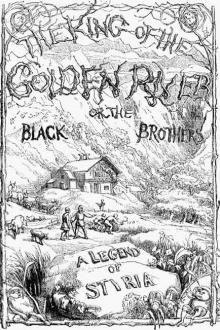
ling-pin no sooner touched the cap, than it flew out of Schwartz's hand, spinning like a straw in a high wind, and fell into the corner at the further end of the room.
"Who are you, sir?" demanded Schwartz, turning upon him.
"What's your business?" snarled Hans.
"I'm a poor old man, sir," the little gentleman began very modestly, "and I saw your fire through the window, and begged shelter for a quarter of an hour."
"Have the goodness to walk out again, then," said Schwartz. "We've quite enough water in our kitchen, without making it a drying house."
"It is a cold day to turn an old man out in, sir; look at my grey hairs." They hung down to his shoulders, as I told you before.
"Ay!" said Hans, "there are enough of them to keep you warm. Walk!"
"I'm very, very hungry, sir; couldn't you spare me a bit of bread before I go?"
"Bread, indeed!" said Schwartz; "do you suppose we've nothing to do with our bread, but to give it to such red-nosed fellows as you?"

the murder was not lacking.
My narrative in "The Night of Hate" is admittedly a purely theoretical account of the crime. But it is closely based upon all the known facts of incidence and of character; and if there is nothing in the surviving records that will absolutely support it, neither is there anything that can absolutely refute it.
In "The Night of Masquerade" I am guilty of quite arbitrarily discovering a reason to explain the mystery of Baron Bjelke's sudden change from the devoted friend and servant of Gustavus III of Sweden into his most bitter enemy. That speculation is quite indefensible, although affording a possible explanation of that mystery. In the case of "The Night of Kirk o' Field," on the other hand, I do not think any apology is necessary for my reconstruction of the precise manner in which Darnley met his death. The event has long been looked upon as one of the mysteries of history - the mystery lying in the fact that whilst the house at Kirk o' Field was destroyed by an e


ly. Feeling despondent, I turned and walked sullenly from thelake's edge into the woodland once more, with no definite purpose inmind, only a meandering thought of my dismal situation. My thoughtsmorphed, in succession, from anxiety to despair, to anger, tofrustration, and in my frustration I knelt down and picked up a fallenbranch from the ground, walked to the nearest tree, and eyed a strange,protruding knob that stuck out from the trunk. I held the branch atshoulder's length and swung it at the knob with all the force of mybuilt up emotions. It hit with a crash and a hollow thud, leaving thebranch broken and my arm sore, but the knob undamaged.
But then something unexpected happened: with a grating noise, a smallhole appeared part way up the trunk, coming from what looked to be solidwood, for no sign was seen before of its having an opening. From thenewly opened hole was then thrust out a head, hairy and with a shortsnout-like edifice for a nose and mouth. Its eyes and the furry hairwhich

op yourself, young chap,
you've got to pay the price,
There are many sorts of visions, but none
of 'em is nice."
They found that day at Leonards Lee and
ran to Shipley Wood,
'Ell-for-leather all the way, with scent
and weather good.
Never a check to 'Orton Beck and on
across the Weald,
And all the way the Sussex clay was weedin'
out the field.
There's not a man among them could
remember such a run,
Straight as a rule to Bramber Pool and on
by Annington,
They followed still past Breeding 'ill
and on by Steyning Town,
Until they'd cleared the 'edges and were
out upon the Down.
Full thirty mile from Plimmers Style,
without a check or fault,
Full thirty mile the 'ounds 'ad run and
never called a 'alt.
One by one the Field was done until at
Finden Down,
There was no one with the 'untsman save
young Jeremiah Brown.
And then the 'untsman '_e_ was beat.

return of its victims, and the other by the almost inviolate safeguards with which it surrounded the prisoners. The return to prison indeed resembled nothing less than a triumph.
The trial recommenced. It was at first attended by the same results as the preceding one. The four accused were protected by an alibi, patently false, but attested by a hundred signatures, and for which they could easily have obtained ten thousand. All moral convictions must fail in the presence of such authoritative testimony. An acquittal seemed certain, when a question, perhaps involuntarily insidious, from the president, changed the aspect of the trial.
"Madam," said he to the lady who had been so kindly assisted by one of the highwaymen, "which of these men was it who tendered you such thoughtful attention?"
This unexpected form of interrogation confused her ideas. It is probable that she believed the facts to be known, and saw in this a means of modifying the fate of the man who interested her.
"It w

ct of Madness onthe part of a Waiter,--and took to his bed (leastwise, your motherand family's bed), with the statement that his eyes were devilledkidneys. Physicians being in vain, your father expired, afterrepeating at intervals for a day and a night, when gleams of reasonand old business fitfully illuminated his being, "Two and two isfive. And three is sixpence." Interred in the parochial departmentof the neighbouring churchyard, and accompanied to the grave by asmany Waiters of long standing as could spare the morning time fromtheir soiled glasses (namely, one), your bereaved form was attiredin a white neckankecher, and you was took on from motives ofbenevolence at The George and Gridiron, theatrical and supper.Here, supporting nature on what you found in the plates (which wasas it happened, and but too often thoughtlessly, immersed inmustard), and on what you found in the glasses (which rarely wentbeyond driblets and lemon), by night you dropped asleep standing,till you was cuffed awak

from the Secretary to the Foreign Department, Government of India, confirms the intelligence that Chinese emissaries have for some time past been endeavouring to re-establish the former predominance of their nation over Tibet and Bhutan. In the former country they appear to have met with little success; but in Bhutan, taking advantage of the hereditary jealousies of the Penlops, the great feudal chieftains, they appear to have gained many adherents. They aim at instigating the Bhutanese to attempt an invasion of India through the duars leading into Eastern Bengal, their object being to provoke a war. The danger to this country from an invading force of Bhutanese, even if armed, equipped, and led by Chinese, is not great. But its political importance must not be minimised.
"'For the most serious feature of the movement is that information received by the Political Department gives rise to the grave suspicion that, not only many extremists in Bengal, but even some of the lesser rajahs a

plinters. Antiquarians differrespecting the intent and meaning of this ceremony, which has beenconstrued and interpreted in many different ways. The strong probability isthat it was done "for luck;" and yet Lord Bateman should have been superiorto the prejudices of the vulgar.]
[Footnote 9:
If my own Sophia.
So called doubtless from the mosque of St. Sophia, at Constantinople; herfather having professed the Mahomedan religion.]
[Footnote 10:
_Then up and spoke this young bride's mother,
Who never vos heerd to speak so free._
This is an exquisite touch of nature, which most married men, whether ofnoble or plebeian blood, will quickly recognise. During the whole of herdaughter's courtship, the good old lady had scarcely spoken, save byexpressive smiles and looks of approval. But now that her object is gained,and her daughter fast married (as she thinks), she suddenly assumes quite anew tone, "and never was heerd to speak so free." It would be diff

s life. He might go on now and become a bad man, or he might cheapen and become an imitation desperado. In either event, his third man left him still more confident. His courage and his skill in weapons gave him assuredness and ease at the time of an encounter. He was now becoming a specialist. Time did the rest, until at length they buried him.
The bad man of genuine sort rarely looked the part assigned to him in the popular imagination. The long-haired blusterer, adorned with a dialect that never was spoken, serves very well in fiction about the West, but that is not the real thing. The most dangerous man was apt to be quiet and smooth-spoken. When an antagonist blustered and threatened, the most dangerous man only felt rising in his own soul, keen and stern, that strange exultation which often comes with combat for the man naturally brave. A Western officer of established reputation once said to me, while speaking of a recent personal difficulty into which he had been forced: "I hadn't been in anyth
ling-pin no sooner touched the cap, than it flew out of Schwartz's hand, spinning like a straw in a high wind, and fell into the corner at the further end of the room.
"Who are you, sir?" demanded Schwartz, turning upon him.
"What's your business?" snarled Hans.
"I'm a poor old man, sir," the little gentleman began very modestly, "and I saw your fire through the window, and begged shelter for a quarter of an hour."
"Have the goodness to walk out again, then," said Schwartz. "We've quite enough water in our kitchen, without making it a drying house."
"It is a cold day to turn an old man out in, sir; look at my grey hairs." They hung down to his shoulders, as I told you before.
"Ay!" said Hans, "there are enough of them to keep you warm. Walk!"
"I'm very, very hungry, sir; couldn't you spare me a bit of bread before I go?"
"Bread, indeed!" said Schwartz; "do you suppose we've nothing to do with our bread, but to give it to such red-nosed fellows as you?"
the murder was not lacking.
My narrative in "The Night of Hate" is admittedly a purely theoretical account of the crime. But it is closely based upon all the known facts of incidence and of character; and if there is nothing in the surviving records that will absolutely support it, neither is there anything that can absolutely refute it.
In "The Night of Masquerade" I am guilty of quite arbitrarily discovering a reason to explain the mystery of Baron Bjelke's sudden change from the devoted friend and servant of Gustavus III of Sweden into his most bitter enemy. That speculation is quite indefensible, although affording a possible explanation of that mystery. In the case of "The Night of Kirk o' Field," on the other hand, I do not think any apology is necessary for my reconstruction of the precise manner in which Darnley met his death. The event has long been looked upon as one of the mysteries of history - the mystery lying in the fact that whilst the house at Kirk o' Field was destroyed by an e
ly. Feeling despondent, I turned and walked sullenly from thelake's edge into the woodland once more, with no definite purpose inmind, only a meandering thought of my dismal situation. My thoughtsmorphed, in succession, from anxiety to despair, to anger, tofrustration, and in my frustration I knelt down and picked up a fallenbranch from the ground, walked to the nearest tree, and eyed a strange,protruding knob that stuck out from the trunk. I held the branch atshoulder's length and swung it at the knob with all the force of mybuilt up emotions. It hit with a crash and a hollow thud, leaving thebranch broken and my arm sore, but the knob undamaged.
But then something unexpected happened: with a grating noise, a smallhole appeared part way up the trunk, coming from what looked to be solidwood, for no sign was seen before of its having an opening. From thenewly opened hole was then thrust out a head, hairy and with a shortsnout-like edifice for a nose and mouth. Its eyes and the furry hairwhich
op yourself, young chap,
you've got to pay the price,
There are many sorts of visions, but none
of 'em is nice."
They found that day at Leonards Lee and
ran to Shipley Wood,
'Ell-for-leather all the way, with scent
and weather good.
Never a check to 'Orton Beck and on
across the Weald,
And all the way the Sussex clay was weedin'
out the field.
There's not a man among them could
remember such a run,
Straight as a rule to Bramber Pool and on
by Annington,
They followed still past Breeding 'ill
and on by Steyning Town,
Until they'd cleared the 'edges and were
out upon the Down.
Full thirty mile from Plimmers Style,
without a check or fault,
Full thirty mile the 'ounds 'ad run and
never called a 'alt.
One by one the Field was done until at
Finden Down,
There was no one with the 'untsman save
young Jeremiah Brown.
And then the 'untsman '_e_ was beat.
return of its victims, and the other by the almost inviolate safeguards with which it surrounded the prisoners. The return to prison indeed resembled nothing less than a triumph.
The trial recommenced. It was at first attended by the same results as the preceding one. The four accused were protected by an alibi, patently false, but attested by a hundred signatures, and for which they could easily have obtained ten thousand. All moral convictions must fail in the presence of such authoritative testimony. An acquittal seemed certain, when a question, perhaps involuntarily insidious, from the president, changed the aspect of the trial.
"Madam," said he to the lady who had been so kindly assisted by one of the highwaymen, "which of these men was it who tendered you such thoughtful attention?"
This unexpected form of interrogation confused her ideas. It is probable that she believed the facts to be known, and saw in this a means of modifying the fate of the man who interested her.
"It w
ct of Madness onthe part of a Waiter,--and took to his bed (leastwise, your motherand family's bed), with the statement that his eyes were devilledkidneys. Physicians being in vain, your father expired, afterrepeating at intervals for a day and a night, when gleams of reasonand old business fitfully illuminated his being, "Two and two isfive. And three is sixpence." Interred in the parochial departmentof the neighbouring churchyard, and accompanied to the grave by asmany Waiters of long standing as could spare the morning time fromtheir soiled glasses (namely, one), your bereaved form was attiredin a white neckankecher, and you was took on from motives ofbenevolence at The George and Gridiron, theatrical and supper.Here, supporting nature on what you found in the plates (which wasas it happened, and but too often thoughtlessly, immersed inmustard), and on what you found in the glasses (which rarely wentbeyond driblets and lemon), by night you dropped asleep standing,till you was cuffed awak
from the Secretary to the Foreign Department, Government of India, confirms the intelligence that Chinese emissaries have for some time past been endeavouring to re-establish the former predominance of their nation over Tibet and Bhutan. In the former country they appear to have met with little success; but in Bhutan, taking advantage of the hereditary jealousies of the Penlops, the great feudal chieftains, they appear to have gained many adherents. They aim at instigating the Bhutanese to attempt an invasion of India through the duars leading into Eastern Bengal, their object being to provoke a war. The danger to this country from an invading force of Bhutanese, even if armed, equipped, and led by Chinese, is not great. But its political importance must not be minimised.
"'For the most serious feature of the movement is that information received by the Political Department gives rise to the grave suspicion that, not only many extremists in Bengal, but even some of the lesser rajahs a
plinters. Antiquarians differrespecting the intent and meaning of this ceremony, which has beenconstrued and interpreted in many different ways. The strong probability isthat it was done "for luck;" and yet Lord Bateman should have been superiorto the prejudices of the vulgar.]
[Footnote 9:
If my own Sophia.
So called doubtless from the mosque of St. Sophia, at Constantinople; herfather having professed the Mahomedan religion.]
[Footnote 10:
_Then up and spoke this young bride's mother,
Who never vos heerd to speak so free._
This is an exquisite touch of nature, which most married men, whether ofnoble or plebeian blood, will quickly recognise. During the whole of herdaughter's courtship, the good old lady had scarcely spoken, save byexpressive smiles and looks of approval. But now that her object is gained,and her daughter fast married (as she thinks), she suddenly assumes quite anew tone, "and never was heerd to speak so free." It would be diff
s life. He might go on now and become a bad man, or he might cheapen and become an imitation desperado. In either event, his third man left him still more confident. His courage and his skill in weapons gave him assuredness and ease at the time of an encounter. He was now becoming a specialist. Time did the rest, until at length they buried him.
The bad man of genuine sort rarely looked the part assigned to him in the popular imagination. The long-haired blusterer, adorned with a dialect that never was spoken, serves very well in fiction about the West, but that is not the real thing. The most dangerous man was apt to be quiet and smooth-spoken. When an antagonist blustered and threatened, the most dangerous man only felt rising in his own soul, keen and stern, that strange exultation which often comes with combat for the man naturally brave. A Western officer of established reputation once said to me, while speaking of a recent personal difficulty into which he had been forced: "I hadn't been in anyth