






















worldlibraryebooks.com - Read eBooks online. Best free library
what has been said it is evident that the short story is artificial, and to a considerable degree unnatural. It could hardly be otherwise, for it takes out of our complex lives a single person or a single incident and treats that as if it were complete in itself. Such isolation is not known to nature: There all things work together, and every man influences all about him and is influenced by them. Yet this separation and exclusion are required by the conventions of the short story; and after all, there is always the feeling, if the characters are well handled, that they have been living and will continue to live, though we have chanced to come in contact with them for only a short time.
It is this isolation, this magnifying of one character or incident, that constitutes the chief difference between the novel and the short story.[8] In the novel we have a reproduction of a certain period of real life: all the characters are there, with their complex lives and their varying emotions; there are varied sce

of bark he had a fire blazing upon the snow by the time the dog mail drew up with its unconscious burden. While the driver was loosening Wabi's clothes and bundling him in heavy bearskins Rod added dry limbs to the fire until it threw a warm glow for a dozen paces around. Within a few minutes a pot of ice and snow was melting over the flames and the courier was opening a can of condensed soup.
The deathly pallor had gone from Wabi's face, and Rod, kneeling close beside him, was rejoiced to see the breath coming more and more regularly from between his lips. But even as he rejoiced the other fear grew heavier at his heart. What had happened to Minnetaki? He found himself repeating the question again and again as he watched Wabi slowly returning to life, and, so quickly that it had passed in a minute or two, there flashed through his mind a vision of all that had happened the last few months. For a few moments, as his mind traveled back, he was again in Detroit with his widowed mother; he thought of the

rack out o' this just about the quickest the law allows! Yes, I DO, now!"
"Wonderful! Marvellous! Incredible! That rara avis, an exception to all exceptions!" declared the professor, more deeply stirred than either of his nephews had ever seen him before. "A genuine tornado which has no eastern drift; which heads as directly as possible towards the northwest, and at the same time--incredible!"
Only ears of his own caught these sentences in their entirety, for now the storm was fairly bellowing in its might, formed of a variety of sounds which baffles all description, but which, in itself, was more than sufficient to chill the blood of even a brave man. Yet, almost as though magnetised by that frightful force, the professor was holding his air-ship steady, loitering there in its direct path, rather than fleeing from what surely would prove utter destruction to man and machine alike.
For a few moments Bruno withstood the temptation, but then leaned far enough to grasp both hand and tiller,
on. Theshuffling of feet, the rattling of chains, the harsh voices of theguard, made it impossible to distinguish any words passing between thetwo. I could only watch them, quickly assured that I had likewiseattracted the girl's attention, and that her gaze occasionally soughtmine. Then the guards came to me, and, with my limbs freed of fetters,I was passed down the steep ladder into the semi-darkness betweendecks, where we were to be confined. The haunting memory of her faceaccompanied me below, already so clearly defined as to beunforgettable.
It proved a dismal, crowded hole in which we were quartered like somany cattle, it being merely a small space forward, hastily boxed offby rough lumber, the sides and ends built up into tiers of bunks, theonly ventilation and light furnished by the open hatch above. Theplace was clean enough, being newly fitted for the purpose, but wastotally devoid of furnishings, the only concession to comfort visiblewas a handful of fresh straw in each bunk. The m

f a figment of the imagination and no one knew that better than the Company itself. It still retained its monopoly nominally, but it made very little effort to restrain the half-breed and other "free traders" who opened up stores and bartered for furs with the Indians. In any case in one form or other all the trade of the country practically came, in the last analysis, through the Hudson's Bay Company, who controlled the money market by having their own bills in circulation. But the wise old Company saw what was coming and began to get ready to let go its monopolistic fur-trading charter and adjust itself to the new conditions.
Hence it was not a difficult matter to persuade the Company to give up its charter for a consideration. My father, who was a member of the Council of Assiniboia, a magistrate, and a close personal friend of Governor McTavish, who was in charge at Fort Garry on the Red River where settlement had begun, always used to say that the Hudson's Bay Company was glad to find a reasonable
ssor, and Andy Sudds went off on occasional hunting trips.
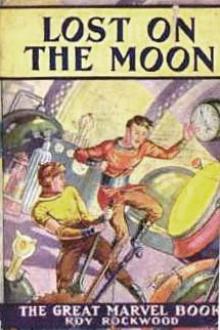
But the spirit of adventure was still strong in the hearts of the boys and the professor. One day, in the midst of some risky experiments at college, Jack and Mark, as related in "Through Space to Mars," received a telegram from Professor Henderson, calling them home.
There they found their friend entertaining as a guest Professor Santell Roumann, who was almost as celebrated as was Mr. Henderson, in the matter of inventions.
Professor Roumann made a strange proposition. He said if the old scientist and his young friends would build the proper kind of a projectile, they could make a trip to the planet Mars, by means of a wonderful motor, operated by a power called Etherium, of which Mr. Roumann held the secret.
After some discussion, the projectile, called the Annihilator, from the fact that it annihilated space, was begun. It was two hundred feet long, ten feet in diameter in the middle, and shaped like a cigar. I

>On Kiley's Run
The roving breezes come and go
Frying Pan's Theology
Scene: On Monaro.
The Two Devines
It was shearing-time at the Myall Lake,
In the Droving Days
`Only a pound,' said the auctioneer,
Lost
`He ought to be home,' said the old man,
`without there's something amiss.
Over the Range
Little bush maiden, wondering-eyed,
Only a Jockey
Out in the grey cheerless chill of the morning light,
How M'Ginnis Went Missing
Let us cease our idle chatter,
A Voice from the Town
I thought, in the days of the droving,
A Bunch of Roses
Roses ruddy and roses white,
Black Swans
As I lie at rest on a patch of clover
The All Right 'Un
He came from `further out',
The Boss of the `Admiral Lynch'
Did you ever hear tell of Chili? I was readin' the other day
A Bushman's Song
I'm travellin' down the Castlereagh, and I'm a station hand,
How Gilbert Died
There's never a stone at the sleeper's head,
The Flying Gang
I served my time, in the days gone by,
Shearing at Castlereagh
The bell is set a-ringing, and the engine gives a toot,
The Wind's Message
There came a whisper down the Bland between the dawn and dark,
Johnson's Antidote
Down along the Snakebite River, where the overlanders camp,
Ambition and Art
I am the maid of the lustrous eyes
The Daylight is Dying
The daylight is dying
In Defence of the Bush
So you're back from up the country, Mister Townsman, where you went,
Last Week
Oh, the new-chum went to the back block run,
Those Names
The shearers sat in the firelight, hearty and hale and strong,
A Bush Christening
On the outer Barcoo where the churches are few,
How the Favourite Beat Us
`Aye,' said the boozer, `I tell you it's true, sir,
The Great Calamity
MacFierce'un came to Whiskeyhurst
Come-by-

dation. This, I say, is the general superstition, and I hope that a few words of mine may serve in some sort to correct it. I ask you, if there is any other people who have confined their national self-laudation to one day in the year. I may be allowed to make one remark as a personal experience. Fortune had willed it that I should see as many--perhaps more--cities and manners of men as Ulysses; and I have observed one general fact, and that is, that the adjectival epithet which is prefixt to all the virtues is invariably the epithet which geographically describes the country that I am in. For instance, not to take any real name, if I am in the kingdom of Lilliput, I hear of the Lilliputian virtues. I hear courage, I hear common sense, and I hear political wisdom called by that name. If I cross to the neighboring Republic Blefusca--for since Swift's time it has become a Republic--I hear all these virtues suddenly qualified as Blefuscan.
I am very glad to be able to thank Lord Coleridge for having, I be
it, but I rather hate it for your own sake. Itisn't worthy of you, old boy. It's so--so ungentlemanly."
"So it is. But I do it because I'm bored. I am bored, you know.Desperately!" He stretched out his hand to her with such haggard,hunted eyes that Laura, reckless, threw herself down by him andkissed the heavy eyelids. Clowes put his arm round her neck,fondling her hair, and for a little while peace, the peace ofperfect mutual tenderness, fell on this hard-driven pair. Butsoon, a great sigh bursting from his breast, Clowes pushed heraway, his features settling back into their old harsh lines ofsavage pain and scorn.
"Get away! get up! do you want Parker to see you through thewindow? If there's a thing on earth I hate it's a dishevelledcrying woman. Write to Lawrence. Say I shall be delighted tosee him and that I hope he'll give us at least a week. Stop.Warn him that I shan't be able to see much of him because ofmy invalid habits, and that I shall depute you to entertainhim. Tha

The Civilization which we of to-day enjoy is a very complex thing, made up of many different contributions, some large and some small, from people in many different lands and different ages. To trace all these contributions back to their sources would be a task impossible of accomplishment, and, while specific parts would be interesting, for our purposes they would not be important. Especially would it not be profitable for us to attempt to trace the development of minor features, or to go back to the rudimentary civilizations of primitive peoples. The early development of civilization among the Chinese, the Hindoos, the Persians, the Egyptians, or the American Indians all alike present features which to some form a very interesting study, but our western civilization does not go back to these as sources, and consequently they need not concern us in the study we are about to begin. While we have obtained the alphabet from the Phoenicians and some of our mathematical and scientific developments through the medium of the Mohammedans, the real sources of our present-day civilization lie elsewhere, and these minor sources will be referred to but briefly and only as they influenced the course of western progress.
The civilization which we now know and enjoy has come down to us from four main sources. The Greeks, the Romans, and the Christians laid the foundations, and in the order named, and the study of the early history of our western civilization is a study of the work and the blending of these three main forces. It is upon these three foundation stones, superimposed upon one another, that our modern European and American civilization has been developed.