



























worldlibraryebooks.com - Read eBooks online. Best free library

riter, therefore, of the present day to choose battles for hisfavourite topic, merely because they were battles, merely becauseso many myriads of troops were arrayed in them, and so manyhundreds or thousands of human beings stabbed, hewed, or shoteach other to death during them, would argue strange weakness ordepravity of mind. Yet it cannot be denied that a fearful andwonderful interest is attached to these scenes of carnage. Thereis undeniable greatness in the disciplined courage, and in thelove of honour, which make the combatants confront agony anddestruction. And the powers of the human intellect are rarelymore strongly displayed than they are in the Commander, whoregulates, arrays, and wields at his will these masses of armeddisputants; who, cool yet daring, in the midst of peril reflectson all, and provides for all, ever ready with fresh resources anddesigns, as the vicissitudes of the storm of slaughter require.But these qualities, however high they may appear, are to befound in the

ite our many guests to a simple "dinner of herbs." Such was man's primitive food in Paradise: "every green herb bearing seed, and every tree in the which is the fruit of a tree yielding seed:" "the green herb for meat for every beast of the earth, and every fowl of the air." What better Preface can we indite than a grace to be said before sitting down to the meal? "Sallets," it is hoped, will be found "in the lines to make the matter savoury." Far be it from our object to preach a prelude of texts, or to weary those at our board I with a meaningless long benediction. "'Tis not so plain as the old Hill of Howth," said tender-hearted witty Tom Hood, with serio-comic truth, "a man has got his belly full of meat, because he talks with victuals in his mouth." Rather would we choose the "russet Yeas and honest kersey Noes" of sturdy yeoman speech; and cheerfully taking the head of our well-stocked table, ask in homely terms that "God will bless these the good creatures of His Herbal Simples to our saving uses, and

e chose twelve men, whom He ordained to the apostleship:--"And He ordained twelve, that they should be with Him, and that He might send them forth to preach."--(Mark 3:14.) Again: "And when it was day, he called unto him his disciples: and of them he chose twelve whom also he named apostles."--(Luke 6:13; compare Matt. 10:1, 2.) The twelve special witnesses of Him and His work were sent out to preach in the several cities of the Jews. On this, their first mission, they were instructed to confine their ministrations to the house of Israel, and the burden of their message was "The kingdom of heaven is at hand."--(Matt. 10:7; study the entire chapter.) They were told to use the power with which they had been invested by ordination, in preaching, in healing the sick, in raising the dead even, and in subduing evil spirits; the Master's admonition was, "Freely ye have received, freely give." They were to travel without money or provisions, relying upon a higher power to supply their needs through the agency of thos

to the opening came Baldy and he peered in, though he remained at a distance of five or six paces. Ronicky Doone poised his gun, delayed the shot, and then frowned in wonder. Baldy had turned and was sauntering slowly back toward his companions.
"Nothing there," he said to the chief, as he approached.
Ronicky hardly believed his ears, but a moment of thought explained the mystery. It was pitch dark behind that screening wall, and the darkness was rendered doubly thick by Baldy's probable conviction that there must be nothing to see behind the fallen roof section. He had come there prepared to find nothing, and he had found the sum of his expectations and no more.
"Sure there ain't?" and Jack Moon nodded. "Which don't mean that you wasn't a fool to light a fire and give somebody a light to shoot you by in case they was somebody lying around. Now, into the saddle both of you. We got a hard ride ahead."
"Something big on hand?" asked Marty Lang.
"There's a lesson for yaller-liv

daub on the easel.
"Ask him, then, if he would not like to learn French."
"To learn French?"
"To take lessons."
"To take lessons, my daughter? From thee?"
"From you!"
"From me, my child? How should I give lessons?"
"Pas de raisons! Ask him immediately!" said Mademoiselle Noemie, with soft brevity.
M. Nioche stood aghast, but under his daughter's eye he collected his wits, and, doing his best to assume an agreeable smile, he executed her commands. "Would it please you to receive instruction in our beautiful language?" he inquired, with an appealing quaver.
"To study French?" asked Newman, staring.
M. Nioche pressed his finger-tips together and slowly raised his shoulders. "A little conversation!"
"Conversation--that's it!" murmured Mademoiselle Noemie, who had caught the word. "The conversation of the best society."
"Our French conversation is famous, you know," M. Nioche ventured to continue. "It's a great talent."
"But
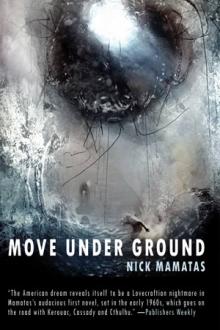
the empty ghost of a road, occasionally swigging some water from my canteen. It was rough in my bloody boots; now my ankles were chafed as well. I balanced the rucksack on my head to keep the sun off of it, but that didn't help, and the straps had already dug into my shoulders, so I took to swinging it, tossing it twenty yards in front of me, and then leisurely strolling over just to pick the sack up. No wonder I wasn't getting any nibbles from the few folks who did drive by.
It got dark fast; there was hardly any dusk at all. And behind me, I heard the roar of a convoy, but they weren't old trucks coming my way. Instead, it was wagons, sedans, curvy Studebakers, and even a few old crank cars with rumble seats and shivering fabric roofs. Town cars driving five abreast in tight formation across only two lanes of highway, eating up the shoulders, headlights suddenly blazing a terrible, beautiful amber. I cut into the wood and watched them zoom past from a little ditch I happened to fall into. Above the

s. They were careful to preserve the number of fighting men and women at 20,000, which is equal to that of the present military force. And so they passed their lives as guardians of the citizens and leaders of the Hellenes. They were a just and famous race, celebrated for their beauty and virtue all over Europe and Asia.
And now I will speak to you of their adversaries, but first I ought to explain that the Greek names were given to Solon in an Egyptian form, and he enquired their meaning and translated them. His manuscript was left with my grandfather Dropides, and is now in my possession...In the division of the earth Poseidon obtained as his portion the island of Atlantis, and there he begat children whose mother was a mortal. Towards the sea and in the centre of the island there was a very fair and fertile plain, and near the centre, about fifty stadia from the plain, there was a low mountain in which dwelt a man named Evenor and his wife Leucippe, and their daughter Cleito, of whom Poseidon became

e of a personal God.
Conscience in man says: "Thou shalt," and "Thou shalt not," "I ought," and "I ought not." These mandates are not self-imposed. They imply the existence of a Moral Governor to whom we are responsible. Conscience,--there it is in the breast of man, an ideal Moses thundering from an invisible Sinai the Law of a holy Judge. Said Cardinal Newman: "Were it not for the voice speaking so clearly in my conscience and my heart, I should be an atheist, or a pantheist, when I looked into the world." Some things are wrong, others right: love is right, hatred is wrong. Nor is a thing right because it pleases, or wrong because it displeases. Where did we get this standard of right and wrong? Morality is obligatory, not optional. Who made is obligatory? Who has a right to command my life? We must believe that there is a God, or believe that the very root of our nature is a lie.
f) The Argument from Congruity.
If we have a key which fits all the wards of the lock, we know that it is t

ture upon his dome as well as the colour decorations!"
"'Tis true, my ancient?" another asked of me.
I made no repartee, continuing to sit with my chin dependent upon my cravat, but with things not the same in my heart as formerly to the arrival of that grey pongee, the grey glove, and the beautiful voice.
Since King Charles the Mad, in Paris no one has been completely free from lunacy while the spring-time is happening. There is something in the sun and the banks of the Seine. The Parisians drink sweet and fruity champagne because the good wines are already in their veins. These Parisians are born intoxicated and remain so; it is not fair play to require them to be like other human people. Their deepest feeling is for the arts; and, as everyone had declared, they are farceurs in their tragedies, tragic in their comedies. They prepare the last epigram in the tumbril; they drown themselves with enthusiasm about the alliance with Russia. In death they are witty; in war they have poetic spas

g himself into liberty and a pension at last, or hadto go out of his gas-lighted grave straight into that other dark onewhere nobody would want to intrude. My humanity was pleased to discoverhe had so much kick left in him, but I was not comforted in the least. Itoccurred to me that if Mr. Powell had the same sort of temper . . .However, I didn't give myself time to think and scuttled across the spaceat the foot of the stairs into the passage where I'd been told to try.And I tried the first door I came to, right away, without any hangingback, because coming loudly from the hall above an amazed and scandalizedvoice wanted to know what sort of game I was up to down there. "Don'tyou know there's no admittance that way?" it roared. But if there wasanything more I shut it out of my hearing by means of a door markedPrivate on the outside. It let me into a six-feet wide strip between along counter and the wall, taken off a spacious, vaulted room with agrated window and a glazed door givin