






























worldlibraryebooks.com - Read eBooks online. Best free library

that ground, for something there is surely underneath that will not suffer the tower to stand?"
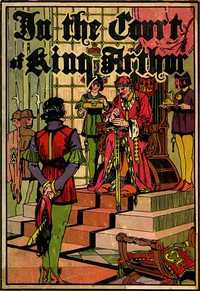
The wizards at these words began to fear, and made no answer. Then said Merlin to the king--
"I pray, Lord, that workmen may be ordered to dig deep down into the ground till they shall come to a great pool of water."
This then was done, and the pool discovered far beneath the surface of the ground.
Then, turning again to the magicians, Merlin said, "Tell me now, false sycophants, what there is underneath that pool?"--but they were silent. Then said he to the king, "Command this pool to be drained, and at the bottom shall be found two dragons, great and huge, which now are sleeping, but which at night awake and fight and tear each other. At their great struggle all the ground shakes and trembles, and so casts down thy towers, which, therefore, never yet could find secure foundations."
The king was amazed at these words, but commanded the pool to be forthwith drained; and surely at

nd we must all know each other. I know I may not be acting according to the present usages of society, but that does not trouble me a little bit."
Accordingly, with the utmost good taste, she introduced me to a number of the people who had been invited.
I need make no special mention of most of them. Some of the young ladies simpered, others were frank, some were fairly good looking, while others were otherwise, and that is about all that could be said. None had sufficient individuality to make a distinct impression upon me. The young men were about on a par with the young ladies. Some lisped and were affected, some were natural and manly; and I began to think that, as far as the people were concerned, the Christmas gathering would be a somewhat tame affair.
This thought had scarcely entered my mind when two men entered the room, who were certainly not of the ordinary type, and will need a few words of description; for both were destined, as my story will show, to have considerable influe

out of sight of Dunedin. I loafed about for a couple of hours, and when the sun got well up some of the other passengers came on deck and joined me. One of them, a little perky sort of fellow, took a good long look at me, and then came over and began talking.
"Mining, I suppose?" says he.
"Yes," I says.
"Made your pile?" he asks.
"Pretty fair," says I.
"I was at it myself," he says; "I worked at the Nelson fields for three months, and spent all I made in buying a salted claim which busted up the second day. I went at it again, though, and struck it rich; but when the gold wagon was going down to the settlements, it was stuck up by those cursed rangers, and not a red cent left."
"That was a bad job," I says.
"Broke me--ruined me clean. Never mind, I've seen them all hanged for it; that makes it easier to bear. There's only one left--the villain that gave the evidence. I'd die happy if I could come across him. There are two things I have to do if I meet him."

craft ofbirch bark like a thing of life, answering cheerfully all hiscompanion's questions. Both were gay and light-hearted. On suchoccasions men lose the superficial, worldly distinctions; they becomehuman beings working together for a common end. Simpson, the employer,and Défago the employed, among these primitive forces, were simply--twomen, the "guider" and the "guided." Superior knowledge, of course,assumed control, and the younger man fell without a second thought intothe quasi-subordinate position. He never dreamed of objecting whenDéfago dropped the "Mr.," and addressed him as "Say, Simpson," or"Simpson, boss," which was invariably the case before they reached thefarther shore after a stiff paddle of twelve miles against a head wind.He only laughed, and liked it; then ceased to notice it at all.
For this "divinity student" was a young man of parts and character,though as yet, of course, untraveled; and on this trip--the first timehe had seen any country but his own and little Switzer


ure of speed like the wind, goaded by fear and knowing the limitations of his rider, was a different matter. The swift flight took her breath away, and unnerved her. She tried to hold on to the saddle with her shaking hands, for the bridle was already flying loose to the breeze, but her hold seemed so slight that each moment she expected to find herself lying huddled on the plain with the pony far in the distance.
Her lips grew white and cold; her breath came short and painfully; her eyes were strained with trying to look ahead at the constantly receding horizon. Was there no end? Would they never come to a human habitation? Would no one ever come to her rescue? How long could a pony stand a pace like this? And how long could she hope to hold on to the furious flying creature?
Off to the right at last she thought she saw a building. It seemed hours they had been flying through space. In a second they were close by it. It was a cabin, standing alone upon the great plain with sage-brush in patches

67, is a certain fact, of which nobody will deny the sister island the honour and glory; but, it seems to me, he was no more an Irishman than a man born of English parents at Calcutta is a Hindoo. Goldsmith was an Irishman, and always an Irishman: Steele was an Irishman, and always an Irishman: Swift's heart was English and in England, his habits English, his logic eminently English; his statement is elaborately simple; he shuns tropes and metaphors, and uses his ideas and words with a wise thrift and economy, as he used his money: with which he could be generous and splendid upon great occasions, but which he husbanded when there was no need to spend it. He never indulges in needless extravagance of rhetoric, lavish epithets, profuse imagery. He lays his opinion before you with a grave simplicity and a perfect neatness. Dreading ridicule too, as a man of his humour--above all an Englishman of his humour--certainly would, he is afraid to use the poetical power which he really possessed; one often fancies in r

ken in the history of theworld. The South Gardens adjoin the Avenue of Palms and extend to theExposition enclosure along the south boundary line, where a wall fiftyfeet high and ten feet wide has been erected of a solid green moss-likegrowth, studded with myriads of tiny pink star-like blossoms. This greatwall is perforated by simple arched masonry entrances, leading rough therichly planted foreground formed by the South Gardens.
Basins of reflecting blue waters extend to the right and left of acentral fountain of colossal proportions. The basins themselves arepunctuated at their east and west ends by fountains of subordinate size,back of which are Festival Hall to the right and the Palace ofHorticulture to the left, as we enter the green wall portals from thecity of San Francisco beyond. To the south and west of the ForeignCountries, States Buildings and Gardens, a graceful contour of hillsextends, sloping onward to Golden Gate, and having a coxcomb of pine andeucalyptus. Broad vistas of cit


fairs of theworld and almost from the world itself, whose faculties are deepenedby suffering and meditation, as far remote from their fellow men asif they were already of the Future--these men look deeply into thedistance, towards the unknowable land of the living and the insane.
"Austria's act is a crime," says the Austrian.
"France must win," says the Englishman.
"I hope Germany will be beaten," says the German.
They settle down again under the blankets and on the pillows,looking to heaven and the high peaks. But in spite of that vastpurity, the silence is filled with the dire disclosure of a momentbefore.
War!
Some of the invalids break the silence, and say the word again undertheir breath, reflecting that this is the greatest happening of theage, and perhaps of all ages. Even on the lucid landscape at whichthey gaze the news casts something like a vague and somber mirage.
The tranquil expanses of the valley, adorned with soft and smoothpastures and hamlets rosy as the rose,