





























worldlibraryebooks.com - Read eBooks online. Best free library

ttalus, a Christian and a Roman citizen, was loudly demanded by the populace and brought into the amphitheatre; but the governor ordered him to be reserved, with the rest who were in prison, until he had received instructions from the emperor. Many had been tortured before the governor thought of applying to Antoninus. The imperial rescript, says the letter, was that the Christians should be punished, but if they would deny their faith, they must be released. On this the work began again. The Christians who were Roman citizens were beheaded; the rest were exposed to the wild beasts in the amphitheatre.
The war on the northern frontier appears to have been uninterrupted during the visit of Antoninus to the East, and on his return the emperor again left Rome to oppose the barbarians. The Germanic people were defeated in a great battle A.D. 179. During this campaign the emperor was seized with some contagious malady, of which he died in the camp, A.D. 180, in the fifty-ninth year of his age. His son Commo

at the very idea of publication in print had hardly occurred to many writers' minds. When the book appeared, both its main contributors, Surrey and Wyatt, had been long dead, as well as others (Sir Francis Bryan and Anne Boleyn's unlucky brother, George Lord Rochford) who are supposed to be represented. The short Printer's Address to the Reader gives absolutely no intelligence as to the circumstances of the publication, the person responsible for the editing, or the authority which the editor and printer may have had for their inclusion of different authors' work. It is only a theory, though a sufficiently plausible one, that the editor was Nicholas Grimald, chaplain to Bishop Thirlby of Ely, a Cambridge man who some ten years before had been incorporated at Oxford and had been elected to a Fellowship at Merton College. In Grimald's or Grimoald's connection with the book there was certainly something peculiar, for the first edition contains forty poems contributed by him and signed with his name, while in the

ndicular walls of the castle, trumpets sounded and mailed guards ran to appointed places at the castle's entrance. The beautiful creature nodded in acknowledgment of their salute as she stepped past them, Jenkins at her side and the eight bodyguards, two abreast, walking behind. Thus they proceeded up the long and narrow courtyard through another entrance, and into an inner courtyard which preceded the entrance hall proper to the castle.
Things happened at a greater pace from then on. At her signal men came forward, took Jenkins with them and, from then until his return to the woman, he was bathed, shaved, and dressed in a wondrously brocaded gown. When he returned, it was to find her in the immense banquet hall.
She motioned him forward and bade him sit at her right. His eyes went wide when he saw who was at her left--Griffin. And dressed in a gown similar to his own.
"Hi, chum," Griffin said. "Nice layout, huh?"
"I like him," Lucretia said, as she signalled for the food to be bro

inished as to lead me to expect that the work will be more generally read in French than in Latin, and better understood. The only apprehension I entertain is lest the title should deter some who have not been brought up to letters, or with whom philosophy is in bad repute, because the kind they were taught has proved unsatisfactory; and this makes me think that it will be useful to add a preface to it for the purpose of showing what the MATTER of the work is, what END I had in view in writing it, and what UTILITY may be derived from it. But although it might be my part to write a preface of this nature, seeing I ought to know those particulars better than any other person, I cannot nevertheless prevail upon myself to do anything more than merely to give a summary of the chief points that fall, as I think, to be discussed in it: and I leave it to your discretion to present to the public such part of them as you shall judge proper.
I should have desired, in the first place, to explain in it what philoso

your hands, my devotion continuing unchanged as I remembered him inclined me to support you. And so with Marcus Aurelius, Publius Minidius, and Gnaeus Cornelius, I was ready to supply and repair ballistae, scorpiones, and other artillery, and I have received rewards for good service with them. After your first bestowal of these upon me, you continued to renew them on the recommendation of your sister.
3. Owing to this favour I need have no fear of want to the end of my life, and being thus laid under obligation I began to write this work for you, because I saw that you have built and are now building extensively, and that in future also you will take care that our public and private buildings shall be worthy to go down to posterity by the side of your other splendid achievements. I have drawn up definite rules to enable you, by observing them, to have personal knowledge of the quality both of existing buildings and of those which are yet to be constructed. For in the following books I have disclosed a

galled by his own poverty. He became foreman of the engineers in the dockyard at Sheerness. Mrs. Morel--Gertrude--was the second daughter. She favoured her mother, loved her mother best of all; but she had the Coppards' clear, defiant blue eyes and their broad brow. She remembered to have hated her father's overbearing manner towards her gentle, humorous, kindly-souled mother. She remembered running over the breakwater at Sheerness and finding the boat. She remembered to have been petted and flattered by all the men when she had gone to the dockyard, for she was a delicate, rather proud child. She remembered the funny old mistress, whose assistant she had become, whom she had loved to help in the private school. And she still had the Bible that John Field had given her. She used to walk home from chapel with John Field when she was nineteen. He was the son of a well-to-do tradesman, had been to college in London, and was to devote himself to business.
She could always recall in detail a September Sund

hed. "I think my way of spelling is just as good as hers."
Bartouki and the boys laughed sympathetically. The little merchant said, "Whatever the spelling, El Mouski will fascinate you. Many things are made there especially for tourists. Some of the workmanship is excellent, and the prices are very low."
"We haven't had much luck with bazaars that cater to tourists," Scotty replied. "We prefer markets where local people buy, because the things are more authentic."
Bartouki chuckled. "That is wise, in most countries. But consider. The attraction for tourists are things that are clearly Egyptian in origin, no? Such things vanished from all but our museums some years ago. You could not buy a genuine Egyptian tapestry, or a stone carving from a tomb. Such things are beyond price. They are national treasures. But you can buy very attractive and authentic reproductions."
"The people of Cairo wouldn't want reproductions, would they?" Barby asked. "So they have to be made just for tourists

s, the rain falling through the leaves, or the dew creeping over the grass and making it silver - would all be tainted for me, and lose their healing power, and their power of communicating joy. To regret one's own experiences is to arrest one's own development. To deny one's own experiences is to put a lie into the lips of one's own life. It is no less than a denial of the soul.
For just as the body absorbs things of all kinds, things common and unclean no less than those that the priest or a vision has cleansed, and converts them into swiftness or strength, into the play of beautiful muscles and the moulding of fair flesh, into the curves and colours of the hair, the lips, the eye; so the soul in its turn has its nutritive functions also, and can transform into noble moods of thought and passions of high import what in itself is base, cruel and degrading; nay, more, may find in these its most august modes of assertion, and can often reveal itself most perfectly through what was intended to desecrate

s. Among the nations ofantiquity, an offering of perfumes was regarded as a token of the mostprofound respect and homage. Incense, or Frankincense, which exudes byincision and dries as a gum, from _Arbor-thurifera_, was formerly burntin the temples of all religions, in honor of the divinities that werethere adored. Many of the primitive Christians were put to death becausethey would not offer incense to idols.
"Of the use of these luxuries by the Greeks, and afterwards by theRomans, Pliny and Seneca gives much information respecting perfumedrugs, the method of collecting them, and the prices at which theysold. Oils and powder perfumery were most lavishly used, for eventhree times a day did some of the luxurious people anoint andscent themselves, carrying their precious perfumes with them tothe baths in costly and elegant boxes called NARTHECIA."
In the Romish Church incense is used in many ceremonies, andparticularly at the solemn funerals of the hierarchy, and o
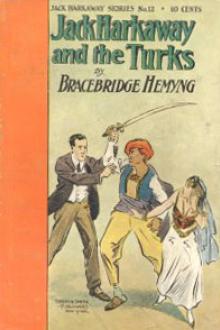
said to himself. "I'm precious glad that young Harkaway warned me, after all. I might have got into some trouble if I had gone ashore without knowing this."
"Stop," said the captain. "Have you any thing to take his excellency as a present?"
This made the orphan feel somewhat nervous.
It tended to confirm what young Jack had said.
"It is, then, the custom to make presents?" he said.
"Yes."
"What shall I give?"
"Any thing. That's a very nice watch you wear."
"Must I give that?"
"Yes. His excellency is sure to present you with a much richer one--that's Turkish etiquette."
This again corroborated Jack's words.
Yet it was a far more pleasant way of putting it than Jack had thought fit to do.
Mr. Figgins only objected to a present of wives.
Any thing rich in the way of jewellery was quite another matter.
"On entering the presence, you have only to prostrate yourself three times; the third time you work it so that you