






















worldlibraryebooks.com - Read eBooks online. Best free library
Description
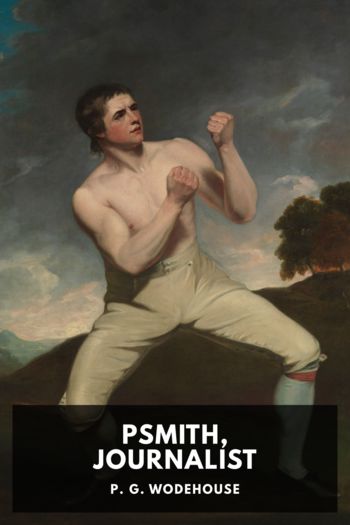
Growing bored while accompanying his Cambridge chum Mike on a cricket tour of the United States, Psmith seeks adventure in New York City. He finds it in the form of the weekly newspaper Cosy Moments, a completely bland and inoffensive publication at which, through charm and sheer force of personality, Psmith appoints himself an unpaid subeditor, fires the entire contributing staff, and embarks on a crusade against the slumlords, gangs, and boxing managers of his holiday destination.
Psmith, Journalist is the second of Wodehouse’s Psmith novels, and is a marked departure from the author’s usual settings and themes. It presents a very strong social justice theme with direct, harsh condemnation of exploitation, corruption, racism, and inequality in early-twentieth century America, and its themes continue to resonate with readers a century later.
The story first appeared in The Captain magazine from October 1909 to February 1910, and was first published as a book, including eight illustrations, by A & C Black in 1915. This Standard Ebook is based on the 1923 edition by the same publisher.

Description
Probably Virginia Woolf’s best-known novel, Mrs. Dalloway, originally published in 1925, is a glorious, ground-breaking text. On the surface, it follows Clarissa Dalloway, an Englishwoman in her fifties, minute by minute through the June day on which she is having a party. At a deeper level, however, the novel demonstrates, through an effortless stream of consciousness, the connections formed in human interaction—whether these interactions are fleeting, or persist through decades.
This is a novel to read and cherish, if only to marvel at Woolf’s linguistic acrobatics. Words and phrases swoop and soar like swallows. Woolf’s sentences are magnificent: sinuous, whirling, impeccably detailed. As narrative perspective shifts from character to character—sometimes within a single sentence—readers come to understand the oh-so-permeable barrier between self and other. Through Clarissa we meet Septimus Warren Smith, his wife Rezia, and a cast of dozens more, all connected by the “leaden circles” of Big Ben marking the passage of every hour, by the pavements of Bloomsbury that lead everywhere and nowhere. Modernist London has never been portrayed more sublimely: replete with birdsong and flowers, resplendent in sunshine, youthful yet eternal—and even in the aftermath of war and pandemic, resilient.
Mrs. Dalloway is Woolf’s attempt to express that which may be inexpressible. It offers a close examination of how difficult it is, even when our hearts are brimming, to say what we really feel; and it examines the damage we inflict through our reticence with words, our withholding of love. It is a novel of the soul, and a work of immense beauty.

Description
Othello was written in 1603 and first performed in 1604. The underlying story is based on “A Moorish Captain,” one of the stories in Cinthio’s Gli Hecatommithi, written in 1565.
Othello is a Moorish black general in Venice, known for his military prowess. He elopes with Desdemona, a noble Venetian lady, who is the daughter of Brabantio, a senator. When Othello promotes Cassio to be his lieutenant over Iago, his ensign, the evil Iago gets his revenge by alleging an affair between Cassio and Desdemona, sowing doubt in the mind of Othello.
This Standard Ebooks production is based on William George Clark and William Aldis Wright’s 1887 Victoria edition, which is taken from the Globe edition.

Description
The first battle of St. Alban’s is over and the White Rose faction is victorious. They have captured Henry VI and, after having threatened him with violence, secured the king’s promise of passing the crown to Edward Plantagenet after his death. Not willing to accept her son’s disinheritance, Queen Margaret decides to take matters into her own hands and declares war on the Yorkists.
Margaret’s forces invade Wakefield Castle, home to the Duke of York and his sons, and successfully capture York. The queen and Clifford taunt York and eventually stab him to death. York’s sons Edward and Richard receive news of their father’s death, vow to get their revenge, and plan to place Edward on the English throne.
This Standard Ebooks production is based on William George Clark and William Aldis Wright’s 1887 Victoria edition, which is taken from the Globe edition.
Description
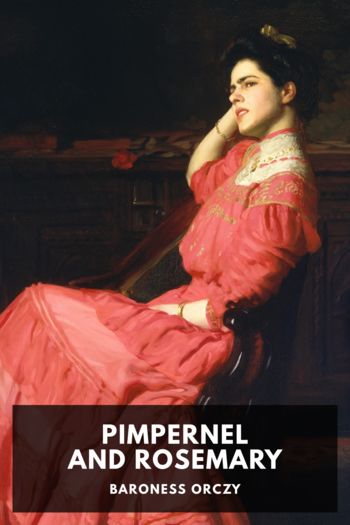
Rosemary, the former love of Peter Blakeney, is about to be married to one of Peter’s friends. A famous journalist, she is asked to come to Transylvania and report on the Romanian occupation following the first World War, having travelled there many times in her childhood with Peter’s mother. She agrees to move up her wedding so that her fiancé can travel with her. Soon after they get there, Peter’s nephew and girlfriend are arrested for treason, and Rosemary is given a terrible choice—all while Peter arrives in the country as well, seemingly working against his own family.
Just as she went back several generations in previous entries in the series, this time the Baroness Orczy goes forward several, to the years immediately following World War I. Having grown up in Hungary, she sets the story in an area of the world very familiar to her, weaving her fictional characters into the real-world history of the time.

Description
Martin Arrowsmith, the titular protagonist, grows up in a small Midwestern town where he wants to become a doctor. At medical school he meets an abrasive but brilliant professor, Gottlieb, who becomes his mentor. As Arrowsmith completes his training he begins a career practicing medicine. But, echoing Lewis’s Main Street, small-town life becomes too insular and restricting; his interest in research and not people makes him unpopular, and he decides to work in a research laboratory instead.
From there Arrowsmith begins a career that hits all of the ethical quandaries that scientists and those in the medical profession encounter: everything from the ethical problem of research protocol strictness versus saving lives, to doing research for the betterment of mankind versus for turning a profit, to the politics of institutions, to the social problems of wealth and poverty. Arrowsmith struggles with these dilemmas because, like all of us, he isn’t perfect. Despite his interest in helping humanity, he has little interest in people—aside from his serial womanizing—and this makes the path of his career an even harder one to walk. He’s surrounded on all sides by icons of nobility, icons of pride, and icons of rapaciousness, each one distracting him from his calling.
Though the book isn’t strictly a satire, few escape Lewis’s biting pen. He skewers everyone indiscriminately: small-town rubes, big-city blowhards, aspiring politicians, doctors of both the noble and greedy variety, hapless ivory-towered researchers, holier-than-thou neighbors, tedious gilded-age socialites, and even lazy and backwards islanders. In some ways, Arrowsmith rivals Main Street in its often-bleak view of human nature—though unlike Main Street, the good to humanity that science offers is an ultimate light at the end of the tunnel.
The novel’s publication in 1925 made it one of the first serious “science” novels, exploring all aspects of the life and career of a modern scientist. Lewis was aided in the novel’s preparation by Paul de Kruif, a microbiologist and writer, whose medically-accurate contributions greatly enhance the text’s realist flavor.
In 1926 Arrowsmith was awarded the Pulitzer Prize, but Lewis famously declined it. In his refusal letter, he claimed a disinterest in prizes of any kind; but the New York Times reported that those close to him say he was still angered over the Pulitzer’s last-minute snatching of the 1921 prize from Main Street in favor of giving it to The Age of Innocence.
Description
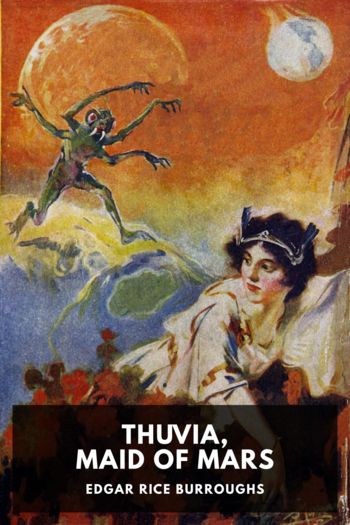
Thuvia, Maid of Mars moves the focus of Burroughs’ Martian series to Carthoris, the son of the human John Carter and Martian Dejah Thoris and the prince of Helium.
Princess Thuvia of Ptarth and Prince Carthoris of Helium are in love. Fate, however, is against them: the princess is promised to another, the Jeddak of Kaol, Kulan Tith. So when the princess is kidnapped, suspicion falls on Carthoris, who sets out as his father would have to rescue the damsel and clear his name. As the great airborn navies of Mars’ military powers charge inexorably towards a needless war, Carthoris pursues the imperiled princess across borders and battlefields, making new enemies and allies along the way on a journey which traverses far and forgotten corners of Barsoom.
Thuvia, Maid of Mars presents many familiar themes from Burroughs’ books, such as damsels in distress, fantastical adventures, chivalry, and derring-do, set against a backdrop of looming war and political intrigue. But it also introduces new elements, such as psychic armies and new flight technologies, as well as bringing entirely new races and settings to the series. It was originally published in 1916 as three serialized parts in All-Story Weekly, and published as a novel in 1920.
Description
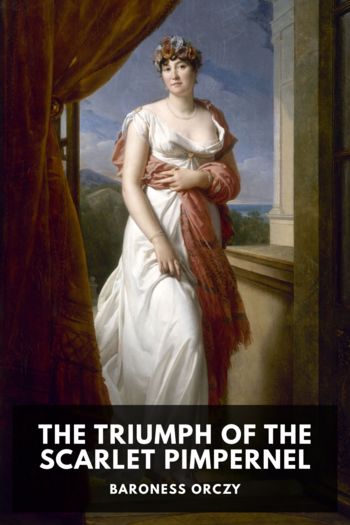
At one of Robespierre’s “Fraternal Suppers,” a young man denounces Robespierre but is saved by an asthmatic vagabond. The young man flees to the home of his friend Theresia Cabarrus, who is engaged to one of the most important men in the government, and who is also desired by Robespierre himself. When the young man disappears from her home, allegedly at the hands of the Scarlet Pimpernel, the ever-present Chauvelin enlists her help in trying to capture the elusive Pimpernel. Events lead to the Pimpernel’s wife being kidnapped, and once again the Pimpernel has to use all of his wits to escape Chauvelin’s clutches with his life, and wife, intact.
As she has done throughout the series, Baroness Orczy weaves the Scarlet Pimpernel into the threads of the history of the Revolution. In this entry, it is the Pimpernel’s interactions with the leading players of the day that eventually leads to Robespierre’s downfall.

Description
At the age of 10, Fanny Price, the daughter of a poor Portsmouth family, is sent to live with her wealthy uncle’s family, the Bertrams, at the country estate of Mansfield Park. The Bertrams treat her cruelly at first, and Fanny has trouble fitting in. Her female cousins, Maria and Julia, are fashionable and vapid, and her elder male cousin, Tom, is a drunk. The only family member she feels a connection to is the younger Edmund, who is preparing for life in the clergy.
When her uncle leaves to manage business in Antigua, Henry and Mary Crawford, siblings from the region, come to live at Mansfield Park as well. Their arrival begins a series of romantic engagements that strains the entire family’s relationships.
Mansfield Park is unusual in that despite it being a great public success, with the first edition selling out in six months and a second edition selling out two years later, it wasn’t publicly reviewed until 1821, seven years after it was first published. Contemporary reviews were generally good, praising the novel’s morality. Modern reviews are more mixed, making it one of Austen’s more controversial works. Modern critics have called it everything from eccentric and difficult to thoughtful and profound, with any number of interpretations possible depending on the lens one views the work through.

Description
At the scene of Marat’s death, in an infamous cabaret in the old section of Paris, in an old abandoned château on the outskirts of the city, in a prison in the midst of the September massacres—the Scarlet Pimpernel and his League may be in all of these places, or they may be in none of them. In these eleven stories Chauvelin, Robespierre, and several other officials each make their attempts to catch the Pimpernel as he intervenes on the side of the innocent and helpless. The question in these stories is not really whether they will snare him, but how he will make his escape—and in some cases, whether he’s there at all.